



Then the Pharisees went and plotted to entrap him in what he said. So they sent their disciples to him, along with the Herodians, saying, “Teacher, we know that you are sincere, and teach the way of God in accordance with truth, and show deference to no one, for you do not regard people with partiality. Tell us, then, what you think. Is it lawful to pay taxes to Caesar or not?” But Jesus, aware of their malice, said, “Why are you putting me to the test, you hypocrites? Show me the coin used for the tax.” And they brought him a denarius. Then he said to them, “Whose head is this and whose title?” They answered, “Caesar’s.” Then he said to them, “Give therefore to Caesar the things that are Caesar’s and to God the things that are God’s.” When they heard this, they were amazed, and they left him and went away.
(Matthew 22:15-22, New Revised Standard Version, Updated Edition)
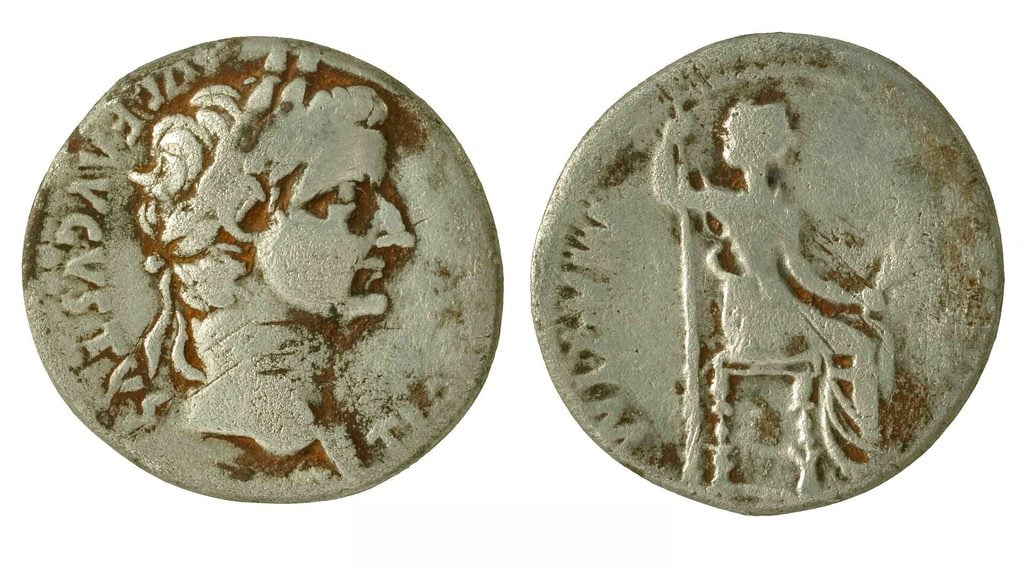
“The earth is the Lord’s and all that is in it.” (Psalm 24:1)
What, then, do we owe the men (and the occasional woman) who set themselves up as Caesars? I’d like to say nothing, save to the extent that we participate in their idolatrous societies. Unfortunately, most of us can’t just hand Caesar back his coins, walk away, and set up a blessed community of our own someplace else. We can attempt to minimize our points of contact with Empire, but a totalizing economic and political system becomes nearly impossible to evade completely.
Why, even Friends Journal owes its ability to so easily share our Quaker messages with so many of you through this newsletter to the commercial development of a communications network that was originally set up by the U.S. Department of Defense. But we have to believe that we can carve out opportunities to do good within an exploitative system. Meanwhile, however, Caesar’s enforcers do their damnedest to force us into obedience and allegiance. And increasingly, these days, they use Christ’s name to justify their efforts to seize control over a world that rightfully belongs to God.
What should Quakers do in such situations? How can we push back against such oppressive systems and remain true to our testimonies?
Friends have faced such questions throughout our history.
In 1670, William Penn wrote The Great Case of Liberty of Conscience in an effort to convince the English government that the Quakers it had spent years persecuting posed no threat to its authority. Though Friends had been called “obstinate and enemies to government,” he said, “the being call’d this, or that, does not conclude us so; and hitherto we have not been detected of that Fact.”
At the same time, he strove to make clear that Friends had an obligation to their creator that overrode the demands placed upon them by the Church of England. “For the Inspiration of the Almighty gives understanding, and Faith is the Gift of God,” Penn wrote, conflating passages from the book of Job and Paul’s letter to the Ephesians—and as such, he explained, only God has the authority to tell us how to worship God. “The poor despised Quakers” had, he said, “in Life and Doctrine[,] espous’d the Cause of God… undoubted Followers of Jesus Christ, in his most Holy, Straight and Narrow Way that leads to the eternal Rest.”
Penn’s Quaker faith led him to believe that “the Christian Religion intreats all, but compels none,” and he considered “imposition, restraint, and persecution” such as he and other Friends faced from the English authorities did “repugnant to the plain Testimonies and precepts of the Scriptures.” Having reviewed every aspect of those testimonies, he asserted, “I know no Treason, nor any Principle that would urge me to a Thought injurious to the Civil Peace.”
In other words: Leave us alone to worship God as we see fit, and stop branding us as enemies of the state because of our faith when we live as dutiful, peaceful citizens.
I find it difficult, though, to let the matter rest there.
Few of us would suggest, after all, that the practice of Quaker faith begins and ends with an hour of silent worship. We strive to place our entire lives in service to God by loving God and loving our neighbors as ourselves. But when our modern Caesars don’t just refuse to welcome the strangers among us, but attempt to incite a racial pogrom against them, as Donald Trump has done with Haitians in Ohio and Somali in Minnesota? When they move to stream firing squad executions over the Internet, as Trump’s so-called “Secretary of War” intends to do just before Christmas? And when they retaliate against those of us still willing to show up for our neighbors, as they did to Renée Good and Alex Pretti? Under such conditions, does not our faith call us to live in prophetic opposition to the status quo of “the civil peace”?
The question has gained a certain urgency, not just in the United States but around the world. And, I believe, we need to begin considering the possibility that there comes a point when liberty of conscience, or obedience to God if you prefer, requires us to pull back on giving Caesars what they consider their due.
Again, let’s acknowledge that few if any of us have the privilege of opting out of Empire altogether. Nor am I advocating direct action against the state. We must continue, as our predecessors did, “to seek peace and ensue it and to follow after righteousness and the knowledge of God, seeking the good and welfare and doing that which tends to the peace of all,” rejecting “all outward wars and strife and fightings with outward weapons, for any end or under any pretence whatsoever” along the way.
Working within those constraints, though, we may still work to erode the power of Caesars, weaken the hold the false gods they serve have on this world, and perhaps accelerate their downfall, clearing the way for a better world to come.
One option of refusal and resistance is to stop paying taxes to “Caesar”. I sid that at one point in my life but after becoming a professional psychotherapist with full time pay and benefits (golden handcuffs), purchasing a house and having respectable standing in my community, the consequences of taxation refusal became too great to continue. As a 78 year old person living in my fully paid off house, I don’t dare risk losing everything I worked so hard for over 46 years of employment. I’ve been retired for almost 8 years and feel very morally compromised by my failure to risk my security & safety by refusing to pay my taxes. Obviously, if I was a billionaire, this wouldn’t be a problem since I’d have an army of tax lawyers to find major loopholes for me!
While it is likely impossible to completely withdraw from supporting and participating in our dominant economic culture, being very conscios of where you source bought things and keeping your economic footprint as small as possible is still an option. I was taught that not paying taxes was a lifestyle choice involving researching the threshold taxable income and then using barter and simplified living to deliberately remain below that income level. It may involve divesting oneself of valuable property, or compromising for a necessary tax (like the home you live in…but still an admirable Quaker practice today?
But much of the evils in our economy today stem from damage done by contractors, huge private corporations, and the in-between practices (like excessive shipping and packaging to evade fair labor costs and wasteful corporate energy/water/resource grabs…). These are only mildly tied to government taxes, and then more with local level incentive tax-break programs. Even a well-healed tax paying Quaker can actively work on minimizing support for these. It usually requires deliberately sourcing locally or direct-from-manufacturer to minimize shipping and warehouse muddle (since it is impossible to trace path and therefore fair trade and resource exploitation practices when middleman conglomeration is layered). It also means accepting that quality and quantity/cheapness are inversely paired – if I want a specific item not available locally, I may pay more to order from its direct manufacturer than from Amazon. And this bulk-warehouse-boycott price is a deliberate ethical choice (because my religion doesn’t believe a worker should be paid less per item if I buy more…so I refuse to support bulk-pricing if I have a choice…)