



Jesus left that place and went away to the district of Tyre and Sidon. Just then a Canaanite woman from that region came out and started shouting, “Have mercy on me, Lord, Son of David; my daughter is tormented by a demon.” But he did not answer her at all. And his disciples came and urged him, saying, “Send her away, for she keeps shouting after us.” He answered, “I was sent only to the lost sheep of the house of Israel.” But she came and knelt before him, saying, “Lord, help me.” He answered, “It is not fair to take the children’s food and throw it to the dogs.” She said, “Yes, Lord, yet even the dogs eat the crumbs that fall from their masters’ table.” Then Jesus answered her, “Woman, great is your faith! Let it be done for you as you wish.” And her daughter was healed from that moment.
(Matthew 15:21-28)
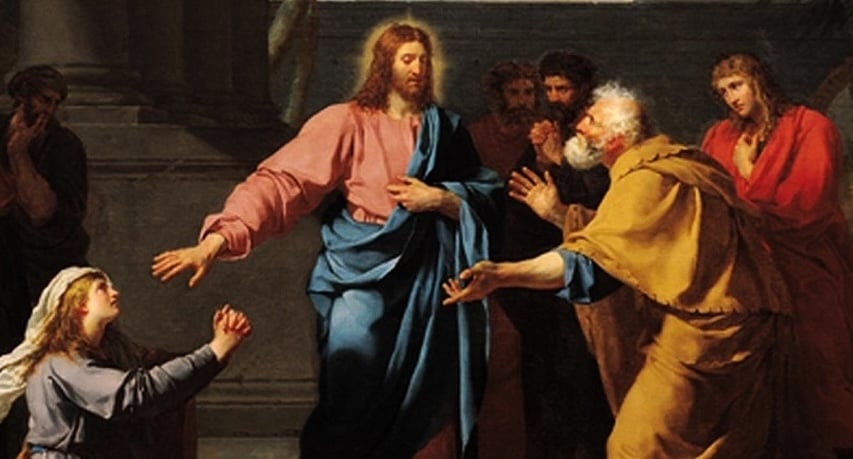
Jesus’s behavior toward the Canaanite woman can disturb some Friends.
Quakers often pride ourselves on our radical openness, our willingness to open the doors of the meeting to everyone, no matter what they believe about God, even if they don’t believe in God at all. So it shocks some people to see Jesus turn the Canaanite woman away because she came from the wrong tribe and then double down on that rejection, comparing the Canaanites to dogs. He relents eventually, impressed by the tenacity with which the woman advocates for her afflicted daughter—especially, as he tells her, the strength of her faith that he can help the girl.
Some people try to rationalize Jesus’s conduct by claiming that he had been testing the woman’s faith. Others suggest he was testing the disciples to find out whether any of them would argue on her behalf. I lean toward a third interpretation: This scene might represent a teachable moment for Jesus, in which he realizes his ministry has truly universal application, that it can do more than just liberate “the lost sheep of the house of Israel.”
Friends have always, from the beginning of the Religious Society, enjoyed the fruits of that lesson. Though early Quakers defined their faith and practice as a form of “primitive Christianity,” of Christian faith brought back to basics, they reckoned that people from other religious traditions could apprehend the Inward Light and strive to live under its guidance, even if they didn’t necessarily comprehend its source as the Spirit of Christ. Friends of a Christ-centered persuasion still believe this; other Friends, of a more universalist bent, look past the details of other theologies, considering them “just as good” as Christianity… or Christianity “just as good” as the others.
Does acceptance into the blessed community require Christian faith?
Many Quakers of previous generations would have said yes without hesitation. The majority of Quakers worldwide today still acknowledge Christ at the heart of their faith. But does that make the thousands of Quakers who do not accept Jesus as their divine savior wrong? Speaking as a Friend who would like very much to believe, I don’t think it does.
The Canaanite woman cries out for help because she has seen what Jesus has done for other people, as the popular meme goes, and she wants that for herself. But she doesn’t call Jesus the “Son of God.” She calls him the “Son of David,” recognizing him as the culmination of a divinely ordained but still ultimately human royal lineage. She believes Jesus can heal her daughter because God bestowed great power upon him to fulfill his mission as Israel’s deliverer, the one who will bring the people back to the original covenant.
She believes in the power of a covenant that does not even welcome her into its community, a community that at its worst does not recognize her as fully human. At a practical level, the covenant often seems to require its participants to love God and to love their neighbors as themselves… except the Canaanites, they suck. She knows this, she lives this every day. Begging an Israelite for help means risking exactly the kind of rejection and degradation that she receives from Jesus at first. But she does it anyway, because she wants to remove her daughter’s affliction, and she believes Jesus can do it precisely because he has come to restore the ancient covenant. She believes in the ability of a people who take up the call to love God and love their neighbors as themselves to overcome the ills and evils of this world.
Friends do well, I think, when we embrace a similar faith.
We don’t all have to believe the same things about God. But, particularly when it comes to membership in a Quaker meeting (as opposed to simply enjoying the benefits of attendance), it does seem helpful if everybody gets on the same page about something.
At a minimum, I think, we ought to believe that a people who love God (whatever that means to them) and love their neighbors as themselves have the power to transform the world… and we ought to commit ourselves to living out that belief by exercising that power. So if someone comes to us and says, “I believe that, and I want to experience the healing that comes from becoming part of a religious society that believes that,” we know enough now to skip past Jesus’s initial rebuffs and give such seekers the opportunity to demonstrate their faith, and join us in the restoration of a blessed community much like the one Jesus championed.
Thoughtful rumination on this less discussed (at least at our meeting) Jesus story. Living in center city Philadelphia I am occasionally approached by strangers for help (I.e. money) and also have had people knocking on our door for help. While it’s always annoying to my dark side, I always remember my mother telling us about how our Quaker grandmother, when approached by a stranger at their little farm, would always give them something to eat and a little money. When my mom would ask her why she’d do that, grandmother would say, “He could be Jesus”.
I am Christian…. currently Roman Catholic but have explored a variety of faiths and.no faith. Quaker faith and practice has fulfilled something in me that has been satisfied nowhere else. Iam profoundly grateful for what I’ve learned at Meeting and in Lower reading about Quakerism.
Two things interest me about the ideas in this article:
1. Jesus grew spiritually during his time here. He didn’t come fully formed as he would have if he was the
God incarnate I was taught to believe. When reading the old testament and then the new, I wonder if God also matured from an adolescent revenge oriented ego driven god to a more compassionate and wiser god.
2. Jesus says, “I was sent”, not “I came”, indicating that, again, he was not “The God” but rather an emissary. Muslims–at least the ones I know– call Jesus (Isa) the “Spirit of God” while Mohammad is “Friend of God”.
My personal understanding is that “Jesus” is a label we have attached to a concept that is much bigger than traditional Christian beliefs. It pains me to see that label now attached to a god that is more like Zeus than to the teachings of the man/prophet/emissary from God I have come to understand and revere, from my reading of the New Testament and my observations of people of faith in other traditions.
No one seems bothered by the fact that Jesus referred to non-Jews as “dogs.”
Would you apply that epithet to another human being?
Hi, Charles! I don’t know that I’d say nobody seems bothered… I mention right at the start that Jesus’s treatment of the woman might shock and disturb readers, and later call attention to “a community that at its worst does not recognize her as fully human.” That felt sufficiently critical to me, but perhaps some readers might want a more explicit condemnation.