



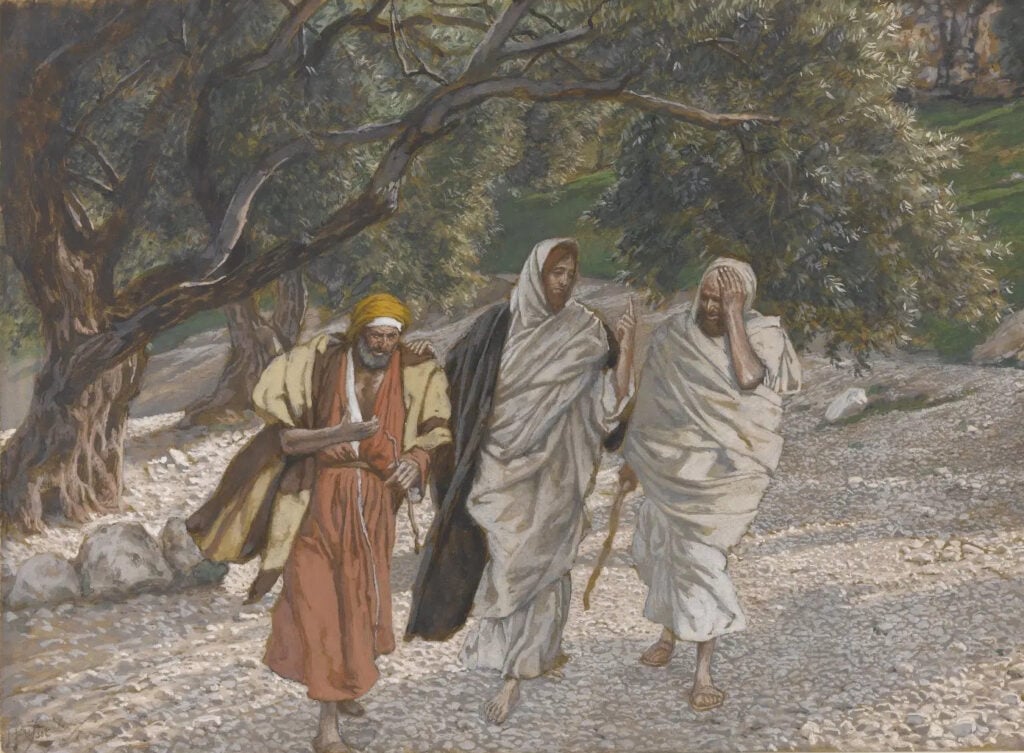
Now on that same day two of them were going to a village called Emmaus, about seven miles from Jerusalem, and talking with each other about all these things that had happened. While they were talking and discussing, Jesus himself came near and went with them, but their eyes were kept from recognizing him. And he said to them, “What are you discussing with each other while you walk along?” They stood still, looking sad. Then one of them, whose name was Cleopas, answered him, “Are you the only stranger in Jerusalem who does not know the things that have taken place there in these days?”
He asked them, “What things?” They replied, “The things about Jesus of Nazareth, who was a prophet mighty in deed and word before God and all the people, and how our chief priests and leaders handed him over to be condemned to death and crucified him. But we had hoped that he was the one to redeem Israel. Yes, and besides all this, it is now the third day since these things took place.
“Moreover, some women of our group astounded us. They were at the tomb early this morning, and when they did not find his body there they came back and told us that they had indeed seen a vision of angels who said that he was alive. Some of those who were with us went to the tomb and found it just as the women had said, but they did not see him.”
Then he said to them, “Oh, how foolish you are and how slow of heart to believe all that the prophets have declared! Was it not necessary that the Messiah should suffer these things and then enter into his glory?” Then beginning with Moses and all the prophets, he interpreted to them the things about himself in all the scriptures.
As they came near the village to which they were going, he walked ahead as if he were going on.But they urged him strongly, saying, “Stay with us, because it is almost evening and the day is now nearly over.” So he went in to stay with them. When he was at the table with them, he took bread, blessed and broke it, and gave it to them.Then their eyes were opened, and they recognized him, and he vanished from their sight.They said to each other, “Were not our hearts burning within us while he was talking to us on the road, while he was opening the scriptures to us?”
(Luke 24:13-32, New Revised Standard Version, Updated Edition)
I almost feel as though I could start and end this message by simply pointing to George Fox’s description of his convincement by Spirit:
“…and when all my hopes in [all men] were gone, so that I had nothing outwardly to help me, nor could tell what to do, then, oh then, I heard a voice which said, ‘There is one, even Christ Jesus, that can speak to thy condition,’ and when I heard it my heart did leap for joy.”
But I should probably elaborate a little further.
I’ve been thinking a lot about the terror and the despair that Jesus’s followers felt in the days immediately following his arrest and crucifixion in Jerusalem. Everyone had looked to Jesus not just for leadership, but for inspiration; without him, they fell into disarray. Jesus had once suggested that Peter would become his successor (Matthew 16:18), but in recent days he’d predicted Peter, along with everybody else, would renounce the movement at the first sign of trouble—and it happened that very night. “The sheep of the flock will be scattered,” Jesus warned (26:31), and indeed some, like Cleopas and his companion, had already decided to get out of town while they still could.
It sounds like Cleopas and his companion may have counted on Jesus to set a political revolution in motion: “We had hoped that he was the one to redeem Israel,” they tell the stranger they meet on the hilly road outside Jerusalem. That doesn’t negate the likelihood that they had a spiritual motivation in joining the movement; after all, they specifically refer to Jesus as “a prophet mighty in deed and word.” And the prophetic tradition within Judaism had always linked Israel’s secular stability to its spiritual condition.
So maybe they had thought Jesus would spur a renewed commitment to the covenant of Sinai, and God would in return give Israel the strength to shake off its Roman oppressors. Or God might take Rome out of the picture some other way; who can understand how God works? In any event, it seemed they had believed one thing for certain: In order to redeem Israel, they needed a living Jesus to lead them.
And they still had one, although they didn’t quite realize it yet.
Just a few hours earlier, some of the women in the movement told their comrades they had visited his tomb and “seen a vision of angels who said that he was alive.” People understandably found that hard to believe, so Peter went to check the tomb himself, saw the abandoned burial linens, and “went home, amazed at what had happened.” (Luke 24:12) According to the account above, it sounds like Peter didn’t go alone, or that another group may have gone to the tomb separately. Whether Cleopas and his companion went to the tomb themselves, or just heard about it later, the news may have freaked them out, and I can’t say I blame them for heading straight to Emmaus that afternoon rather than sticking around before things got any weirder.
Imagine the fear and uncertainty in the voices of Cleopas and his companion as they tell all this to a stranger they’ve just met—who then chastises them for their lack of faith, and gives them a detailed lesson on how the events of the last week—everything they considered a catastrophic failure—had in fact happened in accordance with a divine plan. He speaks to their condition, and eases their minds such that they invite him to eat with them when they reach Emmaus.
Jesus hadn’t revealed himself to them during all this, though. Perhaps he wanted to test their hospitality to see how much of his teachings they’d absorbed. Or he may have just been waiting for them to figure it out on their own, and it didn’t quite click until they heard him bless the bread. That shock of recognition convinces them, and causes them to reflect even further on what he’d told them during the day’s journey: “Were not our hearts burning within us?”
George Fox’s heart burned within him, too, as the hearts of Friends continue to burn today.
We don’t all have the same degree of faith in Jesus that Fox or Cleopas and his companion did. We may find it difficult, some days, to shake off our despair at the damage wrought by the principalities and powers that struggle for control of this world. Despite all that, however, we can still connect with a Spirit that invites us to participate in the creation of a better world. What will it take for us to recognize that invitation, and what will we do next?
As in much of Scripture, I’m not told every thing I would like to know. Ron has tried to fill in some of that. What would be especially helpful, I think, would be the complete list of everything he “interpreted to them… about himself in all the scriptures.”