



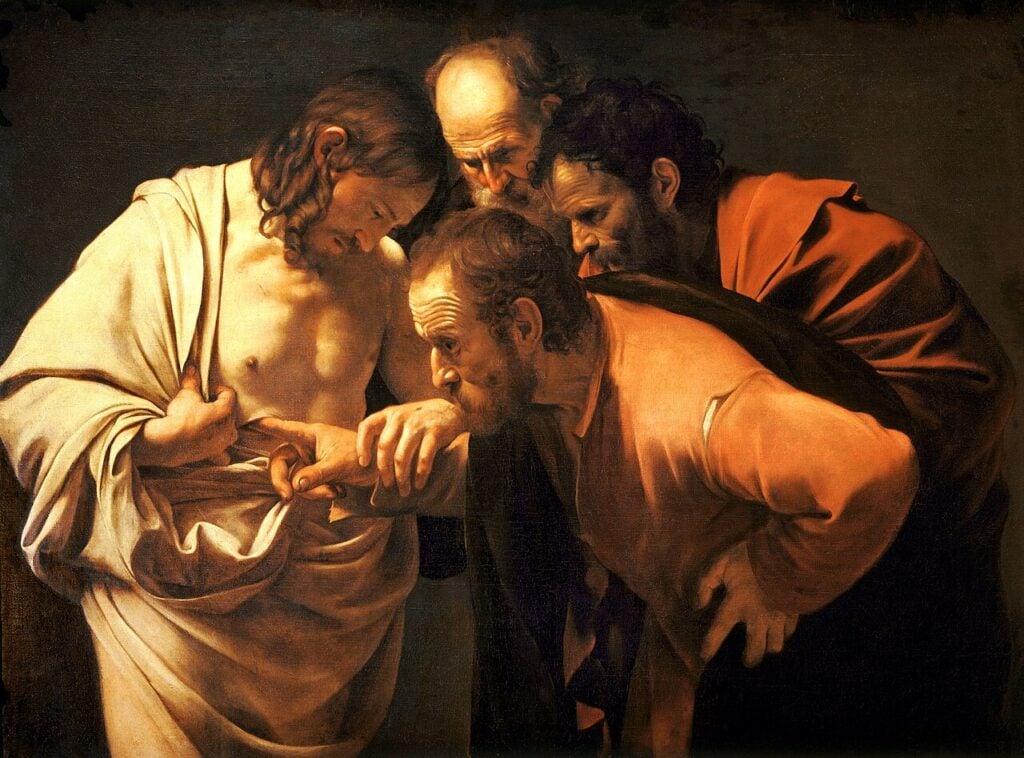
Thomas (who was called the Twin), one of the twelve, was not with them when Jesus came. So the other disciples told him, “We have seen the Lord.” But he said to them, “Unless I see the mark of the nails in his hands and put my finger in the mark of the nails and my hand in his side, I will not believe.”
A week later his disciples were again in the house, and Thomas was with them. Although the doors were shut, Jesus came and stood among them and said, “Peace be with you.” Then he said to Thomas, “Put your finger here and see my hands. Reach out your hand and put it in my side. Do not doubt but believe.” Thomas answered him, “My Lord and my God!” Jesus said to him, “Have you believed because you have seen me? Blessed are those who have not seen and yet have come to believe.”
(John 20:24-29)
Thomas did not just “doubt” the other apostles who saw Jesus before him.
Let’s look closely at what Jesus tells Thomas in John 20:27: mē ginou apistos alla pistos. Literally, this reads as “[do] not be unbelieving but believing.” I can see why English-language translators might tweak that in the direction of “Do not doubt but believe,” as the New Revised Standard Version does, or “Stop doubting and believe,” as it reads in the New International Version. These come across as forceful commands.
The earliest Quakers, however, would either have read Jesus’s instruction to Thomas as “be not faithless, but faithful” (in the Geneva Bible of 1560) or “be not faithless, but believing” (in the King James translation). Likewise, a recent translation by the Orthodox theologian David Bentley Hart, aiming to preserve the connotations of the original Greek, says, “cease to be faithless, but be faithful instead.” The distinction matters: Faithlessness carries a much more profound weight than doubt, especially in the matter of a resurrected Christ.
The Greek bears this out. Apistos shows up in another gospel story, one that appears in Matthew, Mark, and Luke. A man brings his son to Jesus; the boy suffers from fits, and though some of Jesus’s disciples had tried to cure him, none had succeeded. “You faithless and perverse generation!” Jesus cries out before healing the boy himself. When the disciples want to know why they failed, Matthew says Jesus tells them they had oligopistian, or “little faith” (17:20). In Mark’s version, the boy’s father begs (9:24), “Pisteuō boēthei mou tē apistia” or “I believe, help my unbelief!” Again: Unbelief means something much more significant here than doubt.
We know this because the gospels have other words for doubt.
When Peter tries to join Jesus on the surface of the sea but becomes frightened, Jesus chastises him (Matthew 14:31): “You of little faith, why did you doubt?” (Oligopiste eis ti edistasas?) Later, in Matthew’s account of the resurrection, Mary Magdalene and the other Mary tell the apostles to go straight to Galilee to reunite with Jesus. When they found him there (28:17), “prosekynēsan hoi de edistasan,” or “they worshiped him, but some doubted.”
The Greek verb here, distázō, literally means “to stand double,” to doubt in the sense of hovering uncertainly between two options. Peter wants to believe Jesus will keep him safe on the open waters, but his senses tell him otherwise. The apostles at Galilee want to believe Jesus has come back from the dead, but some of them can’t quite convince themselves, even though he’s standing right there, talking to them.
Similarly, when the apostles ask Jesus how he cursed a fig tree, he tells them that they can accomplish anything through prayer, “if you have faith and do not doubt” (Matthew 21:21) or “if you do not doubt in your heart but believe that what you say will come to pass” (Mark 11:23). Both versions use a form of the Greek verb diakrinó, which literally means “to judge back and forth.” Sometimes this carries a sense of careful discernment, but more often than not it describes hesitation, wavering, a lack of commitment.
Thomas didn’t doubt Jesus had returned. He refused to accept the possibility whatsoever.
He required proof—but once he had it, he immediately went all in, acknowledging Jesus as “my Lord and my God.” He experienced something akin to what the earliest Quakers called convincement, the acceptance of “the revelation of God’s Spirit,” as Robert Barclay described it—specifically, the revelation of God’s Spirit as an active presence in this world, a presence that compels us to push past our state of sinfulness and transform our lives that we might attain union with it.
I can’t recall hearing of any Quakers who experienced their convincement in as literal a manner as Thomas. (But feel free to send me the stories, if you have them!) Spirit moves differently in the world these days, or rather we perceive Spirit’s movements differently—perhaps because many Friends no longer connect Spirit so definitively to Christ. We are still called to faith, however—called to choose belief and active engagement, rather than standing on the sidelines, unable to commit to anything. Some people can happily get there on their own; I say “happily” because, like David Bentley Hart, I prefer to read the Greek makarios as “blissful” rather than “blessed.” Thomas’s story reminds us that those who need divine assistance will very likely get it—and it will come not with judgment or criticism, but with an invitation to peace.
For me it is not a binary choice of believe or not believe, to have faithful or faithless, but to question whether these “words of Jesus” were ever spoken by Jesus. I have a low level of confidence that these were the words of Jesus. I have a higher degree of confidence that these words were placed in the mouth of Jesus by Christians decades or even centuries after the death of Jesus. A Quaker value and testimony is Integrity. Call me a Doubting Thomas if you wish.
Ron Hogan: Thanks for this information and analysis. I appreciate your stating that word choices and connotations in different Bible translations affect the meaning. I find that in the King James Version, words’ connotations speak to the inward experience, whereas in most other translations, the words often fall flat. I will look for David Bentley Hart’s translation; it would be encouraging to find a contemporary theologian who conveys the meaning of the original.
Raymond Elberson: Whether or not these words of Jesus were ever spoken by Jesus is not the standard by which Friends have historically assessed their credibility. Rather the standard is whether the words find purchase through the Light or Truth in the heart, a standard that is unavailable until given by grace, and is then called “faith.” To open oneself to this inestimable gift, one might read early Friends writings and see what’s standing in the way. Here’s George Fox (Works 4:78): “your hearts be afar off, who be strangers to the life of his law . . . turn things upside down that must be turned upside down before the life of the law, which is light, be known, and your eyes opened . . . and such, owning not the life of the law, they owned not Christ when he came, who was the end of it . . . and so Isaiah’s words came to be fulfilled, that were spoken forth from the life, when Christ came who was the life, they that had the words of the law and were out of the life, knew him not . . . which were gone from the life of the law, the light, which Christ was one with.” The “life of his law” means the Spirit that brings forth the words.
A fantastic column, as always. A suggestion. The verb underlying (a)pistos is “pisteuo.” In the long history of Christian interpretation we have used religiously-coded words to translate Greek words that in fact have quotidian, non-religious meanings. My favorite is “baptizo” being translated as “baptize,” a word which has, in English, no meaning other than its religious one. But the Greek word means “immerse” and could be used to describe your laundry or dinner dishes as much as a religious ritual. “Faith” and “Believe” are two such English words with specifically religious connotations. The Greek verb means to trust, not to subscribe to religious propositions, especially ones that baffle the senses or contradict science. “Faith(ful)(ness)” is a perfectly good translation of the adjective “pistos,” but “Faith” still carries that heavy weight of religious meaning in English. In also obscures a fundamental ambiguity in the Greek: “pistos” can mean both “trusting” and “trustworthy.” So “Don’t be un-trustworthy, but trustworthy” is as good a translation as “Don’t be un-trusting [right, not a real word], but trusting. It’s tricky both to remove the religious overtones that have been layered on over the centuries, AND to preserve the delicious ambiguity in the Greek. A similar problem obtains in Paul’s use of the word that is so often translated with variants of “believe” and “faith,” when the not-so-religious “trust” captures his meaning and its connotations more accurately.
I am a non-aligned Christian who left organized religion over 20 years ago. I have read The Quaker Way and use it as a reference piece in my faith journey.
I am confused by this statement. Does this connote non-belief in the Trinity?
Sincerely,
“Spirit moves differently in the world these days, or rather we perceive Spirit’s movements differently—perhaps because many Friends no longer connect Spirit so definitively to Christ.”
Hi, Steven! That’s a great question. When I wrote that, I meant to acknowledge that many Friends today do not regard “Spirit” as “the Spirit of Christ” in the way early Friends did, and would not even consider themselves “Christian” as we generally understand the term. But your reading—that some Friends may have a non-trinitarian view of Christ—probably holds true in some cases, too!
I imagine most Friends in resolutely Christ-centered meetings believe in the classical Trinity, but the non-creedal nature of our faith community makes it hard to say that with great certainty. Honestly, if you wanted to know whether a given Friend believes in Christ and the Trinity, and they don’t tell you unprompted, you’d have to ask them!