



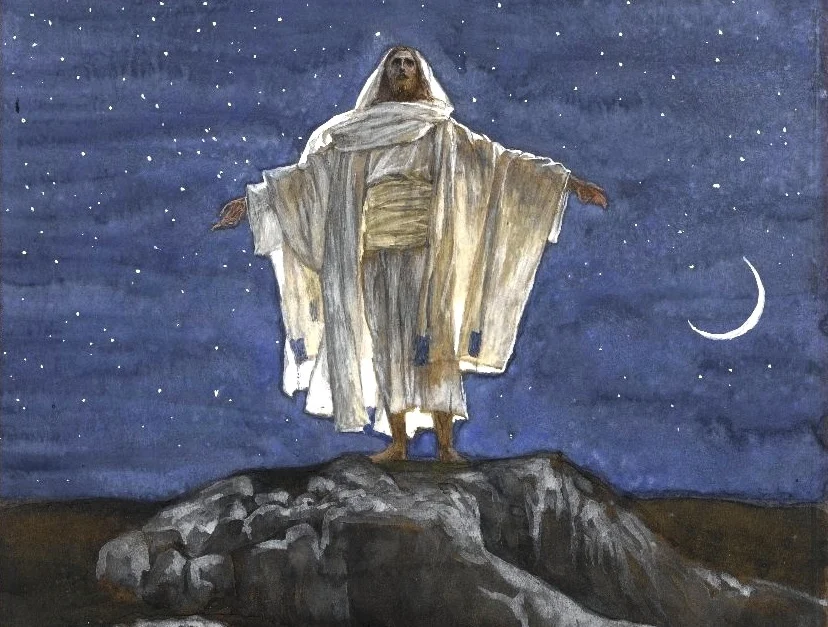
Immediately he made the disciples get into a boat and go on ahead to the other side, while he dismissed the crowds. And after he had dismissed the crowds, he went up the mountain by himself to pray. When evening came, he was there alone, but by this time the boat, battered by the waves, was far from the land, for the wind was against them. And early in the morning he came walking toward them on the sea. But when the disciples saw him walking on the sea, they were terrified, saying, “It is a ghost!” And they cried out in fear. But immediately Jesus spoke to them and said, “Take heart, it is I; do not be afraid.”
(Matthew 14:22-27, New Revised Standard Version, Updated Edition)
As last week’s message ended, Jesus was tending to five thousand seekers.
He had just learned about the execution of John the Baptist, and headed out from Nazareth to the Sea of Galilee, where he could have some time to himself on the water. But the people from the nearby towns followed him, and he saw them all gathered on the shore just outside Capernaum.
A few days after I shared my thoughts on this passage, the progressive Christian writer Diana Butler Bass sent out her own commentary, raising a point I found extremely helpful. She explained that the crowd also knew what had happened to John the Baptist—that they were seeking Jesus out because of John’s death. They recognized the strong bond between the two men, whether they knew about any family connection or simply saw Jesus’s ministry as a continuation (to say the least) of John’s.
“Maybe they wanted to comfort [Jesus],” Bass writes; “maybe they wanted to see what he would do. Were they crying, too? Shocked by the cruelty of imperial violence? Angry that their respected holy men were being imprisoned and killed? Afraid for themselves?”
Whatever the crowd’s motivation, whether they saw Jesus as John’s successor or as a prophet in his own right, they tracked him down because they believed in the possibility of a better world, one where they didn’t live under Roman subjugation, where they could live in right relationship with God and one another. Maybe, after John’s death, they feared that world might slip out of their grasp. Maybe they hoped Jesus would usher that world into existence. A few people among them might even have understood exactly how he would do it.
Jesus saw the faith of all these people, and he came ashore to share in their grief and address their suffering.
Then, finally, he went up into the mountains to pray by himself.
As I mulled over these passages, I started thinking about the early Quakers, and the stories George Fox told in his journals. I thought about the sermon at Firbank Fell, where a thousand people gathered to hear Fox preach for three hours, and about Pendle Hill, where “the Lord let me see in what places he had a great people to be gathered.” For historical accuracy, I have to acknowledge that Fox climbed Pendle Hill before he visited Firbank Fell—no neat mirror of Jesus here! And no need to draw so precise a parallel, either: it suffices to observe both men preached in an era where political turmoil spurred spiritual revival.
You may have noticed, as you read the passage from Matthew above, that I ended the story early. I left out the part about Peter attempting to follow Jesus onto the water, losing faith, and nearly drowning but for Jesus dragging him back into the boat. As with the actual multiplication of the loaves and fishes, I don’t know quite what to say about it, and so I feel myself drawn to the quieter moments in these readings. Why did Jesus want some time by himself? And what did he do when he finally got it?
Matthew can’t tell us; he and the other disciples had already set out in their boat, trusting that Jesus would meet them on the other side of the sea in a day or two. (Little did they know!) They had a lot in common with the thousands who had turned out the day before—they shared the same anxieties, the same hopes for deliverance from oppression. Joining Jesus’s entourage didn’t fully allay those concerns; in some ways, it often left them more confused than before.
Peter’s story emphasizes that confusion, but we don’t have to focus our attention there.
I know some of you reading this don’t believe in Jesus’s divinity. No worries; I still go back and forth on the matter, much as I’d like to believe wholeheartedly. Maybe it makes things easier for you to see this as the story of a spiritual leader praying for clarity in the wake of a tragedy that affected him personally as much as it affected the movement to which he belonged. Perhaps that scenario resonates with you, as a seeker in a world of turmoil yourself. Perhaps, seeing Jesus as fully human, you can also see him as seeking the One who could speak to his condition, who could inspire him to keep going forward—to catch up to his closest companions and let them know he had not abandoned them, that despite all the hardships they faced, they had no need of fear. And those of us who see “that of God” in Jesus as something more than a mark of his humanity might appreciate the fullness of that humanity, including its rough edges, and admire how, once he had addressed his own emotional and spiritual needs, he went back out with renewed confidence to continue helping others.
Keeping in contact with God sometimes requires being alone for a while.