


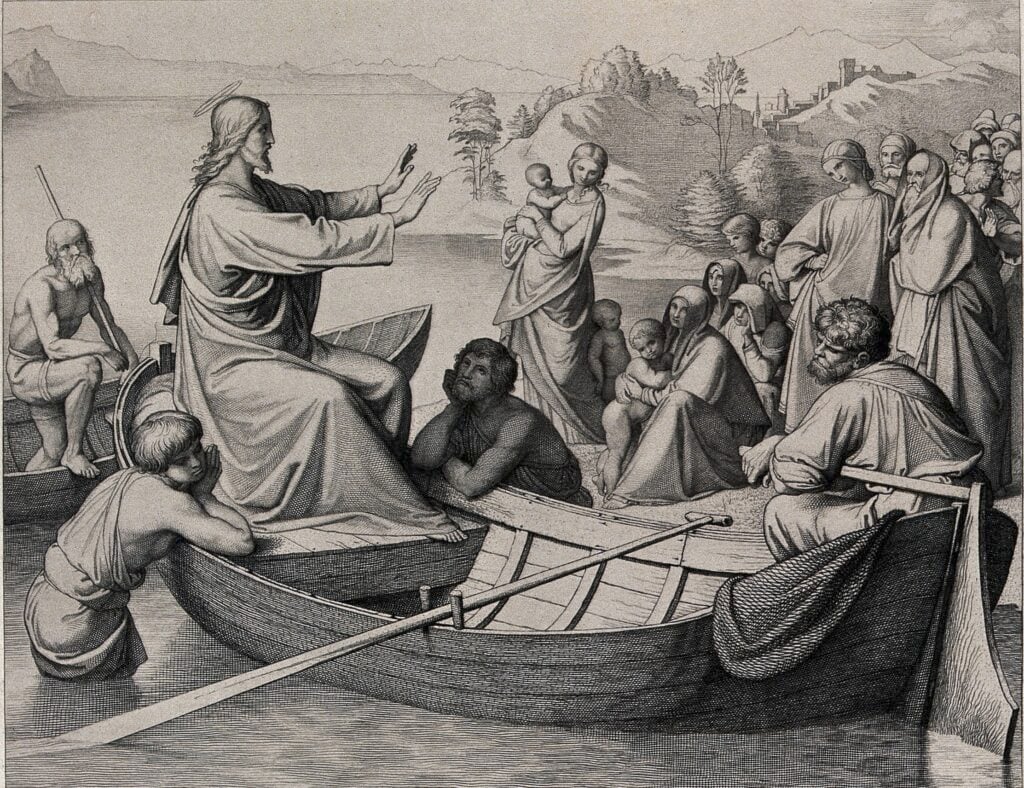
[Jesus withdrew] in a boat to a deserted place by himself. But when the crowds heard it, they followed him on foot from the towns. When he went ashore, he saw a great crowd, and he had compassion for them and cured their sick. When it was evening, the disciples came to him and said, “This is a deserted place, and the hour is now late; send the crowds away so that they may go into the villages and buy food for themselves.” Jesus said to them, “They need not go away; you give them something to eat.”
(Matthew 14:13-16, New Revised Standard Version, Updated Edition)
Jesus never set out to feed five thousand people at one event.
You can see it in the beginning of the story: He was trying to get away from everybody. Why? He had just visited his hometown of Nazareth, where people, still remembering him as the carpenter’s boy, refused to accept him as a spiritual teacher, let alone a miracle worker. “Where did this man get this wisdom and these deeds of power?” they scoffed (13:54).
Jesus took it in stride, observing that “prophets are not without honor except in their own hometown and in their own house,” but because they refused to believe, he deliberately held back on performing miracles there (13:57-58). Meanwhile, about 85 miles to the south, in Jerusalem, Herod Antippas, heard stories about the “deeds of power” Jesus was doing elsewhere and immediately freaked out. He’d recently had John the Baptist, one of his most vocal critics, executed, and now became convinced that John had come back in the form of Jesus to torment him further.
The timeline here actually gets a bit muddled, because first Matthew tells us about Herod’s fears (14:1), then he backtracks to fill in the details of John’s death, and then, after John’s disciples have buried his body, they leave Jerusalem to give Jesus the news (14:12). This brings us back to where we started: “Now when Jesus heard this, he withdrew from there in a boat to a deserted place by himself.”
John’s death would have affected Jesus greatly.
Although none of the other gospels mention it, Luke describes John the Baptist as a member of Jesus’s extended family. We never hear about any early connection between the two, but even if they never met as children or adolescents, let’s imagine for a moment that Jesus had heard about John and his prophetic ministry—the family must have talked about it at some point. As he came to terms with his own holy mission, Jesus would have realized that he’d have to visit his distant cousin and offer himself up for baptism.
Maybe you don’t believe Luke’s backstory, though. We can set it aside. That still leaves us with Jesus learning about the execution of a prophet who had helped set him off on his ministry with a baptism that became, by several accounts, a public anointing from on high. The messengers who caught up to Jesus just outside Nazareth bearing the news of John’s death may also have brought a warning (we’re returning to the muddled timeline finally) that Herod’s attention had now turned to him.
Did Jesus feel the need to lay low for a while, for the apostles’ sake if not his own? Or did he simply want some time to process his grief, on top of whatever frustrations he might have felt about how poorly things had gone in Nazareth? Whatever the reason, he decided to put some distance between himself and the public, and no doubt thought to avoid encountering anybody on the road by taking a shortcut over the Sea of Galilee.
The people he sought to avoid had other ideas.
They figured he might head to Capernaum, which had become his home base, and according to tradition they caught up to him at a place called Tabgha, just over a half-hour’s walk southwest of that village. Keep in mind that the entire population of Capernaum at that time has been estimated at about 1,500 people—now think about the impact a crowd of five thousand showing up on the outskirts of town would have. You’d probably notice them from a boat, too, especially if you were staying close to the shoreline.
So Jesus came to shore and was so moved by the faith these people had demonstrated by coming out to see him that he began healing the sick among them. (The Greek word describing his compassion means “he felt it in his internal organs,” literally a visceral reaction.) When it got late, and the apostles wanted to send the crowd away, he refused to let the moment end.
The more I think about it, that engagement with the crowd lands harder with me than the miracle that follows. Maybe I find the multiplication of the loaves and fishes too big to wrap my head around, but I can still relate to someone who shows up to help a bunch of strangers, even as he was dealing with his own troubles. I think we might all take inspiration from that.
(This week’s message takes some cues from the Jesuit author James Martin’s excellent Jesus: A Pilgrimage.)
Beautifully written. I too am intrigued by the lesson of Jesus helping these many strangers during what must have been a difficult time for him. Yes, the miracle of the loaves and fish is amazing, but how generous of Jesus to put aside his desire to be alone, to rest, to help these people! How can this translate to our own lives? Yes, we must take care of ourselves. At the same time, how easy is it to over focus on our own trials and tribulations? What a gift it is when we help another person. How often do we feel better when we focus our love on our friends and neighbors than when get lost in ourselves. Thank you for contributing this lovely essay.
Keep telling the stories Mr. Hogan. You make the story come to life and what it can mean to us.