


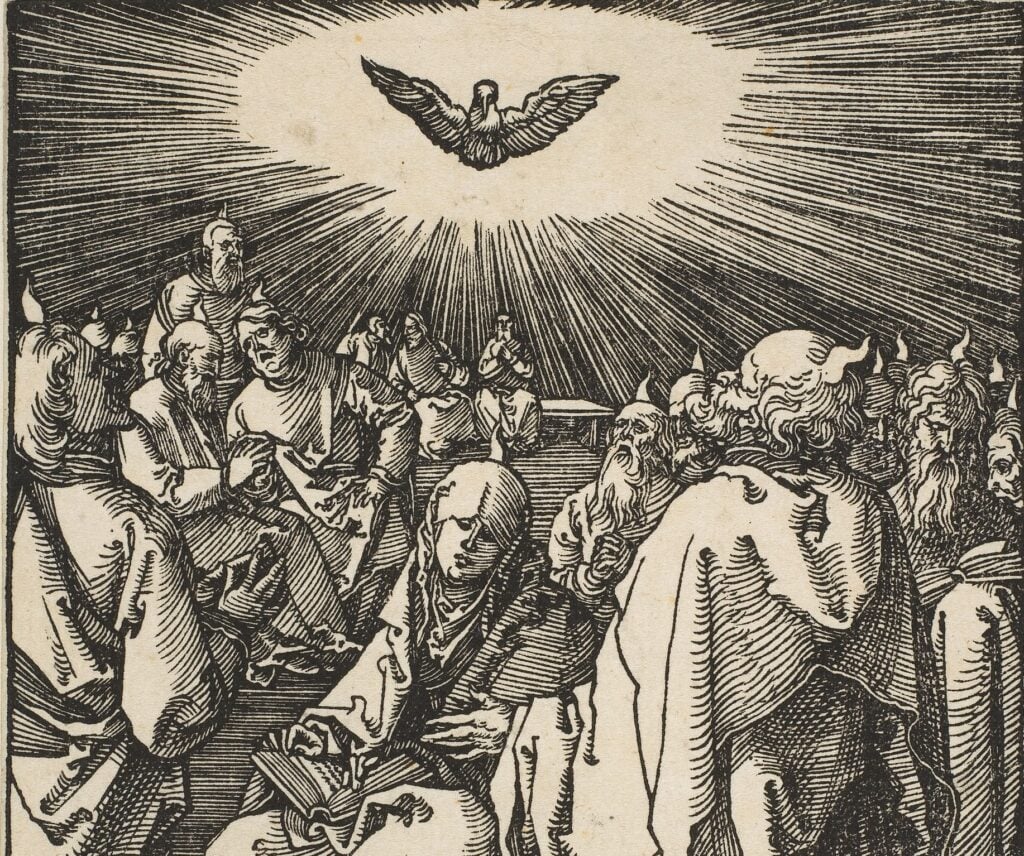
All of them were filled with the Holy Spirit and began to speak in other languages, as the Spirit gave them ability.
Now there were devout Jews from every people under heaven living in Jerusalem. And at this sound the crowd gathered and was bewildered, because each one heard them speaking in the native language of each… All were amazed and perplexed, saying to one another, “What does this mean?” But others sneered and said, “They are filled with new wine.” But Peter, standing with the eleven, raised his voice and addressed them, “Fellow Jews and all who live in Jerusalem, let this be known to you, and listen to what I say. Indeed, these are not drunk, as you suppose, for it is only nine o’clock in the morning. No, this is what was spoken through the prophet Joel:
‘In the last days it will be, God declares,
that I will pour out my Spirit upon all flesh,
and your sons and your daughters shall prophesy,
and your young men shall see visions,
and your old men shall dream dreams.‘”(Acts 2:4-6,12-17, New Revised Standard Version, Updated Edition)
I worried about whether I could write this week’s message.
Last year, when Pentecost came around, I considered how it took place less than two months after the death of Jesus of Nazareth, the head of a growing spiritual movement within the Jewish community in the conquered kingdom of Judea. The Roman Empire, seeing Jesus and his followers as a potential threat to their dominion over their province, had him crucified—a grisly, public execution meant to squelch any other impulses toward resistance.
And yet Jesus came back from the dead within a matter of days. Many people found this hard to believe at the time; so do many people today, even people who recognize Jesus as a profound spiritual teacher. But the rest of this story makes much more sense if we, like billions of Christians today (including the majority of Quakers worldwide), take the leap of faith and accept his resurrection as reality. So: Jesus returned to his disciples, and though he couldn’t stay long, he instructed them on how to sustain the movement they had started until his promised return.
“You will receive power when the Holy Spirit has come upon you,” Jesus assured them just before he left them (Acts 1:8-9), “and you will be my witnesses in Jerusalem, in all Judea and Samaria, and to the ends of the earth.” So they went back to the city and sought to discern what they should do next.
Soon enough, as I wrote last year, “the Holy Spirit came down among the apostles, and filled them with inspiration to face the crowds and deliver the same message for which their leader had been killed.” More than this, though, the Spirit made it so everyone in that crowd understood this message, hearing it in their own language.
What could I add to that first account?
At first I turned my attention to what Peter had told them, about his invitation to repent of their sins and “save yourselves from this corrupt generation.” (Acts 2:40) With these words, he made a specific callback for his Jewish audience to Moses’s final address to the Israelites, warning of “a perverse and crooked generation” that would “do what is evil in the sight of the Lord, provoking him to anger through the work of your hands.” (Deut 32:5, 31:29)
I could, at this point, invite you to look at the top stories in your favorite news outlets, see what has become of the world, and draw your own conclusions. That feels too easy, though—and a little too close to doomsday thinking, especially since I just spent last week discussing why Quakers don’t go in for that sort of thing. So I’ll skip over Peter’s warnings that “the sun shall be turned to darkness and the moon to blood” (Acts 2:20), and focus instead on what I consider a much more exciting part of his message.
He reminded the crowd of the message the Lord gave the prophet Joel, and some context will prove helpful here. Joel’s prophetic speech begins by describing just how bad things have gotten: “A nation has invaded my land, powerful and innumerable,” the Lord declares (1:6); “its teeth are lion’s teeth, and it has the fangs of a lioness.” Peter didn’t need to discuss those lines out loud for this crowd to understand him; the mere act of quoting Joel in Roman-occupied Jerusalem made a clear statement. So he jumped straight to what the Lord said would happen at the end of this desolate era: “I will pour out my Spirit upon all flesh.”
The prophetic imagination will spread among all the people, not just a few.
We aren’t talking about seeing what will happen tomorrow, but about recognizing what has gone wrong with the world today—and why. Prophets critique the current social order, inviting people to join them in imagining a different path forward. The more people we have out there prophesying in this manner, sharing their visions and dreams with each other, the less powerful the secular world’s grip on our minds becomes. We question authority, we become increasingly ungovernable, we lay the foundations for a better way of living.
The first generations of Quakers knew what it felt like to have Spirit poured out upon them in this way, and they met much the same skepticism and persecution the earliest Christians had faced as they tried to share that joy. But Rome fell, and the British Empire became a shadow of its former self, and other unjust principalities will in time crumble, unable to fortify themselves forever against a community that draws strength from its adherence to a more blessed covenant.
I really like this brief essay as it points to the dual nature of the prophetic call which is both sounding an alarm (we are going the wrong way and not listening to God which will bring dire consequences) and at the same time presenting a different and powerful, life sustaining vision of hope, peace, and reconciliation. Friends in all our different traditions are continuing to try to do this today but many of us are feeling discouraged and despairing. We see our world moving rapidly toward the destruction of all we hold to be true, right, and affirming of The Light within each person. We wonder what we can do to stand up to such momentous evil.
We are finding (to our dismay) that the strength and courage we need to challenge this evil does not come from our own ability to “make things right.” Instead, just as in the story of Pentecost and in the lives of the Hebrew prophets, it came from recognizing that we need help from a Power greater than our own. It comes from a deep and honest recognition that we have not been listening to God, we have lost our way. It comes for waiting for that Power and Spirit to speak to us and guide us. Asking and praying together for that Power to change us and lead us forward.
We see ourselves as extremely capable and self-sufficient people and have lost our dependence upon God. The prophet Isaiah spoke to such a people, “This is what the Great Spirit, the Holy One.. says: ‘Your healing and peace will come when you turn back to me and rest in my promises. Your power will grow as you settle down and trust in me.’ But you were not willing to listen.” (30:15, First Nations Version)