


Beloved, do not be surprised at the fiery ordeal that is taking place among you to test you, as though something strange were happening to you. But rejoice insofar as you are sharing Christ’s sufferings, so that you may also be glad and shout for joy when his glory is revealed. If you are reviled for the name of Christ, you are blessed, because the spirit of glory, which is the Spirit of God, is resting on you. But let none of you suffer as a murderer, a thief, a criminal, or even as a mischief maker. Yet if any of you suffers as a Christian, do not consider it a disgrace, but glorify God because you bear this name. For the time has come for judgment to begin with the household of God; if it begins with us, what will be the end for those who do not obey the gospel of God? And
“If it is hard for the righteous to be saved,
what will become of the ungodly and the sinner?”(1 Peter 4:12-18, New Revised Standard Version, Updated Edition)
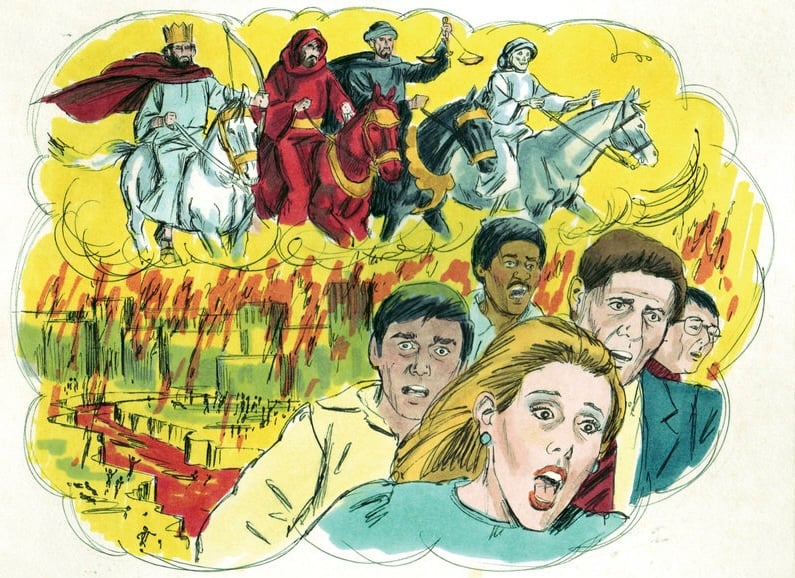
When I was growing up, people believed the world might end at any moment.
They had good reason to think so, what with the United States and the Soviet Union each possessing enough nuclear weapons to destroy the planet several times over. We were also approaching the end of a millennium, at least by the Christian calendar, and that inspired a great deal of anxiety, which manifested itself in ways reflecting a predominantly Christian culture.
I’m thinking primarily of the evangelical dispensationalist Hal Lindsey’s The Late Great Planet Earth, a look at the political landscape of the 1970s through the lens of Biblical prophecy that sold millions of copies—perhaps more than any other nonfiction book that decade. Viewing the foundation of Israel in 1948 as the first in a series of “signs,” Lindsey imagined how the luridly detailed visions from the Book of Revelation might play out on the twentieth-century stage.
The book did so well that in 1978 Orson Welles narrated a documentary adaptation, which featured interviews with Lindsey and various political and scientific experts. Three years later, Welles turned up again as the narrator of The Man Who Saw Tomorrow, a similar film about the “prophecies” of the sixteenth-century French physician and astrologer Nostradamus. With his usual flair for the dramatic, Welles recounted how people believed Nostradamus had foreseen events spanning from the French Revolution to the Second World War—laying the groundwork for the cataclysmic scenario that might lie in the future. (Welles himself believed none of this, and spoke dismissively of Nostradamus outside the film’s immediate context.)
Most people may not have taken this sort of stuff seriously—as a kid, I rarely encountered any “doomsday” stories without a strong dose of skepticism or outright mockery. But mass media bolstered their cultural presence, and they ultimately found their audience. In some ways, their influence endures to this day.
Such apocalyptic thinking, though, does not typically feature in Quaker spirituality.
I don’t know about you, but I’m not looking at Donald Trump’s resurrection of the threat of nuclear war, nor his regime’s rapid assault on the nations domestic institutions, as a fiery ordeal meant to test me. Does it all frighten me? I’d be lying if I said it hadn’t, and it probably will again. Of course, it doesn’t end at the American border; nations all over the world are dealing with their own political and cultural upheavals, plus you’ve got the planet-wide environmental emergencies. And how you and I and everyone else respond to these interlocking crises matters—it matters at an existential level, for each of us as individuals and for the world as a whole—yet I cannot see God’s hand in it.
Humanity brought these conditions upon ourselves by allowing an economic system that prioritizes the concentration of wealth among a few over the prosperity of all to become so dominant that the ability of ships to pass through a small body of water, just twenty-four miles at its narrowest point, can have global consequences. So I don’t see the “end of the world” looming on the horizon in all this. Instead, my mind turns to something the science fiction writer William Gibson said in an interview, back in the 1990s: “The future is already here—it’s just not very evenly distributed.”
That cuts both ways. On the one hand, the cutting edge technology of the late twentieth century has become ubiquitous, practically standard issue. But the political and economic anxieties the relatively privileged middle class are experiencing today? The global underclass have been living under these conditions for a long time, and the logic of Empire convinced the rest of the world to accept it as unfortunate but inevitable.
The blessed community grows out of the rejection of that logic.
That future has already arrived, too. Peter knew it when he told his fellow early Christians “the time has come for judgment to begin with the household of God.” The early Quakers became convinced of it when they considered their own fiery ordeal in seventeenth-century England and concluded that the Spirit of Christ had already returned to guide them through the chaos. And Friends today do their best to distribute the blessed community more evenly across the world, though not always with the specifically Christian zeal of previous generations.
“Let there be peace on earth,” as the opening line of a popular hymn from the 1950s goes, “and let it begin with me.” If Quakers were looking for a mission statement, that would probably serve us well as we set out to confront the unpeaceful circumstances in which we find ourselves today.
Thanks for your insightful remarks!
The advent of supercomputers has complicated our problems.
What is known as AI…or “artificial intelligience” {artificial stupidity?} results in critical decisions big made at the speed of light..before important factors can be considered. In addition, important feedback is being repressed….to hasten the speed with which sometimes barbaric supercomputer decisions can be made.
The number of nuclear weopons in the world, has drastically increased. Only by unleashing public opposition to the threat of nuclear weopons, can we achieve what we did in the 1980s……..a reduction of this threat.
Lets work to prevent nuclear war!
Perhaps we need to listen to each other more.