


“When the Son of Man comes in his glory and all the angels with him, then he will sit on the throne of his glory. All the nations will be gathered before him, and he will separate people one from another as a shepherd separates the sheep from the goats, and he will put the sheep at his right hand and the goats at the left. Then the king will say to those at his right hand, ‘Come, you who are blessed by my Father, inherit the kingdom prepared for you from the foundation of the world, for I was hungry and you gave me food, I was thirsty and you gave me something to drink, I was a stranger and you welcomed me, I was naked and you gave me clothing, I was sick and you took care of me, I was in prison and you visited me.’
(Matthew 25:31-35)
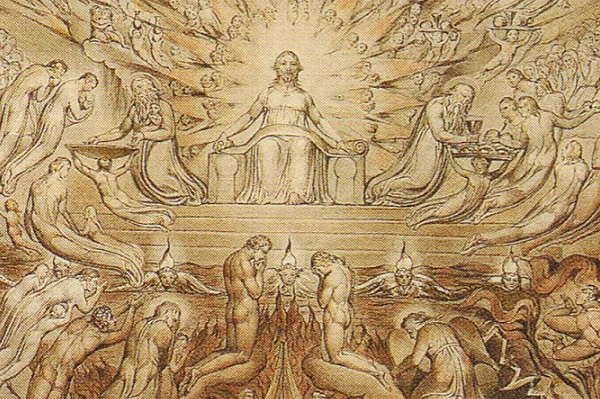
What does Christ mean when he promises us a kingdom?
It depends on what we mean by kingdom, and when Jesus spoke to his disciples about the end of their present age, he did not have an ordinary nation-state in mind. “My kingdom does not belong to this world,” as he would tell Pontius Pilate after his arrest in Jerusalem. (John 18:36) In both these cases, and many others besides, the gospels use the Greek word basileia. That word often refers to a kingdom in the way we understand the term—a nation-state governed by a monarch—but at a deeper level, it describes the condition of royalty, the ruling power of a royal entity.
So Jesus wasn’t just saying that Pilate wouldn’t find his “kingdom” on any map. He also meant that his authority did not derive from any worldly power structure, in the way that Pilate’s authority came from Rome, and Rome’s authority came ultimately from military and economic dominance. No, Jesus came to offer humanity something that God had set up for us at the very beginning of creation, because God had chosen us, in the words of the Geneva and King James Bibles, “that we should be holy, and without blame before [God] in love.” (Ephesians 1:4).
The nineteenth-century biblical scholar Joseph H. Thayer described Christ’s kingdom as “that perfect order of things which he was about to establish, in which all those of every nation who should believe in him were to be gathered together into one society, dedicated and intimately united to God, and made partakers of eternal salvation.” He pointed well beyond political realms as we know them to our very state of existence. In the kingdom, he said, we would live in eternal communion with God. We would, in other words, become holy.
Jesus didn’t spring that on the disciples out of nowhere.
He spoke of a promise made long ago, when God had sent Abraham out to receive his inheritance. A promise formalized during the flight from Egypt, when God had Moses assemble the Israelites at Moab and invite them to choose between life and prosperity or death and adversity. When Jesus reminded his disciples of this promise, he followed in the footsteps of all the Hebrew prophets who had confronted the people of Israel as they suffered under foreign oppressors. You do not have to live like this, the message went—and if you love one another as you ought to love God, you will find your way to a better life.
In this instance, Jesus laid out the ground rules as plainly as he could. He tells his audience how the Son of Man will reward those who pay attention to those around them and give their neighbors in need material aid and comfort, because “just as you did it to one of the least of these brothers and sisters of mine, you did it to me.” (Matthew 25:40) Conversely, those who did not show kindness and consideration to their neighbors will protest that they would have helped the Son of Man if they had seen him in need, and he will tell them, “Just as you did not do it to one of the least of these, you did not do it to me.” (25:45)
I don’t know about you, but from childhood on, I’ve usually heard this story presented as a blunt warning: Do good, go to heaven; fail to do good, go to hell. And I didn’t learn much about heaven, other than that all the good people lived happily ever after, nor about hell, other than that all the sinners suffered miserably for eternity.
I don’t think the story ends there, though.
When we think of the Blessed Community, we probably imagine a city or a town much like the one in which we live now, only all the good parts have become perfect, and all the bad parts improved away. We picture ourselves living cheerful lives in harmony with everyone around us. But “inheriting the kingdom” means more than a permanent residency in the ultimate gated community.
Look again at the layers of meaning in basiliea, especially the sense of royalty, of possessing a royal nature. When we become, as Thayer says, intimately united to God, existing in a state of perfect order, we too will possess that nature. We will do good things not because God commands us to do so, but because we have the mind of Christ within us, and that mind expresses itself by showing love for all of God’s creation. The “kingdom of God” is within us (Luke 17:21), and every act of steadfast love toward our neighbors draws that basiliea out, makes it stronger, and brings us closer to God.
And in that closeness—that communion—we will find ourselves blessed.
We want to hear from you, not an AI! Please be thoughtful and use your own words. Comments on Friendsjournal.org may be used in the Forum of the print magazine and may be edited for length and clarity.