



Both we and our ancestors have sinned;
we have committed iniquity, have done wickedly…
They made a calf at Horeb
and worshiped a cast image.
They exchanged the glory of God
for the image of an ox that eats grass.
They forgot God, their Savior,
who had done great things in Egypt,
wondrous works in the land of Ham,
and awesome deeds by the Red Sea
Therefore he said he would destroy them—
had not Moses, his chosen one,
stood in the breach before him,
to turn away his wrath from destroying them.
(Psalm 106:6, 19-23, New Revised Standard Version, Updated Edition)
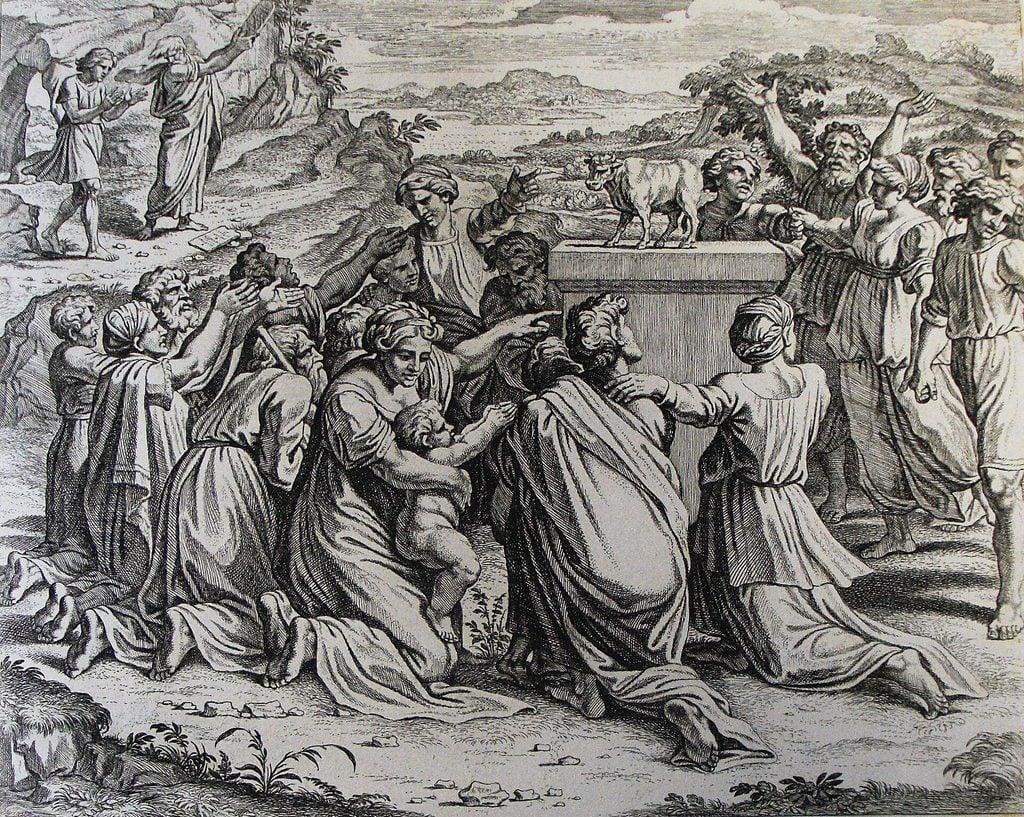
Many of us learned the story of the golden calf as children.
I don’t know how many Easters I watched The Ten Commandments on TV growing up, but I still have vivid memories of Edward G. Robinson, as the wicked Dathan, whipping the Israelites into a panic in Moses’s absence. Of the crowd parading a bright yellow statue of a cow around the camp, dancing before it and offering it a young woman as a human sacrifice. And, of course, of Charlton Heston’s Moses, returning from Mount Sinai with the stone tablets bearing God’s commandments, appalled by what has transpired. “Those who will not live by the law shall die by the law!” he shouts, hurling the tablets at the golden statue. The idol promptly explodes, the ground beneath it splits open, and Danath and his followers plunge into the abyss.
I can see how people might come away from this story stuck on the notion of a cruel and vindictive God. The film version actually downplays the violence of Moses’s reaction; in Exodus, he commands the Levites to “go back and forth from gate to gate throughout the camp, and each of you kill your brother, your friend, and your neighbor,” leading to the slaughter of approximately 3,000 Israelites (32:26-27). And this represented a compromise from God’s original plan to kill all of Israel and replenish the nation with Moses and his descendants.
Moses, however, convinces God to forgive the Israelites for their weakness and their lack of faith. His intervention allows them to continue their journey to the promised land—but “they [had] no faith in [God’s] promise,” the psalmist informs us (106:24), and as a result they will continue to make a mess of things.
And by “they,” I could very easily mean “we.”
“They mingled with the nations and learned to do as they did,” the psalm goes on:
“They served their idols,
which became a snare to them.
They sacrificed their sons
and their daughters to the demons;
they poured out innocent blood,
the blood of their sons and daughters,
whom they sacrificed to the idols of Canaan,
and the land was polluted with blood.
Thus they became unclean by their acts
and prostituted themselves in their doings.” (106:35-39)
People and nations have fallen under the sway of the gods of this world in just this way over and over again. Their ancient names have largely faded from memory, although Mammon and Moloch still retain a certain strength as a poetic label we sometimes use to speak out against forces like capitalism or imperialism. (When we do, though, we take care to make sure nobody thinks we mean it literally, lest they question our sanity.) No, instead of anthropomorphic deities, today people worship power more directly, in the form of money or authority over other people’s lives.
Not even Quakers can claim to have fully avoided such iniquity.
Remember how many Friends took part in the enslavement of other human beings until discernment finally led the Religious Society toward abolition. Remember how many Friends participated in the brutal forced assimilation of indigenous North Americans into White Christian society. And think about our own meetings today: How often do we shortcut our discernment and make business decisions based on long-term financial health rather than Spirit’s prompting? How often do we put off living testimonies in support of our oppressed neighbors out of consideration for Friends who can barely acknowledge the existence of a gross social imbalance, let alone one they (and we) have helped perpetuate?
I don’t say this to negate the good that the Quakers who came before us did, nor the work that many of us continue to do today. We need to remember, however, that we cannot do the work alone, and we cannot do it with the gods of this world, for it directly opposes their power over us.
Instead, we must trust, as George Fox did, that “Christ was come to teach his people Himself, by His power and Spirit in their hearts.” Maybe you don’t believe in Christ as Fox did. If you want to call the power that can bring us off from all the world’s ways by another name, go ahead. Under any name, however, the invitation remains: Trust that this power can speak to your condition—and that it offers you a perfect law of love that will lead you straight to the blessed community.
Amen!