


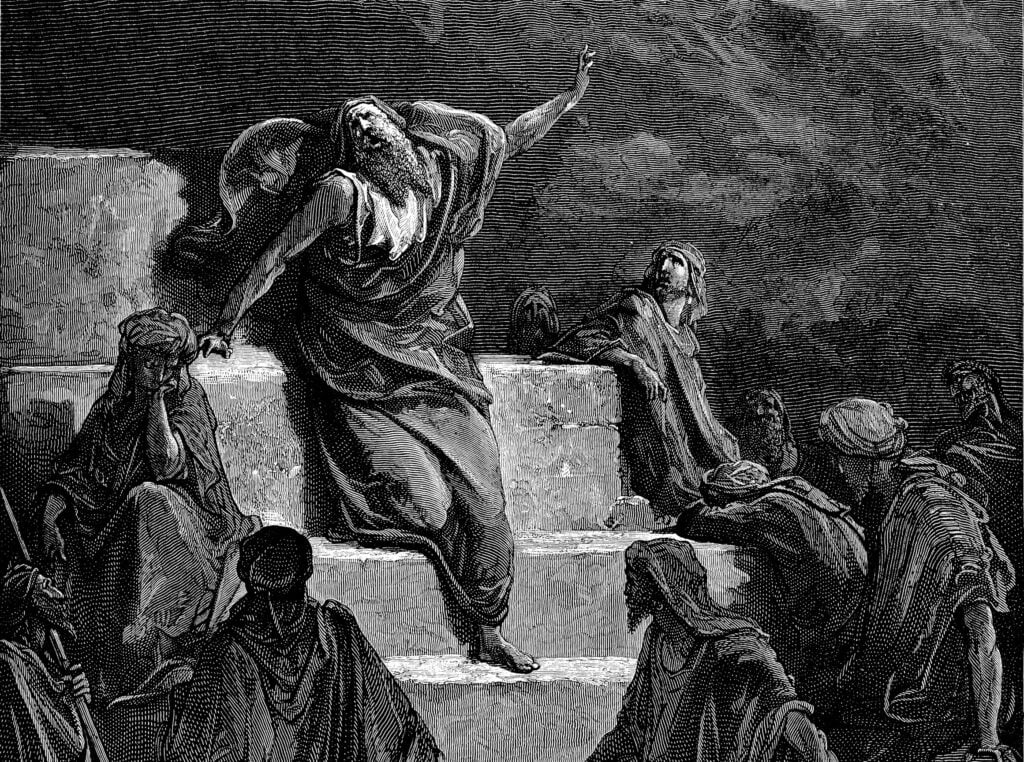
…I have become a laughingstock all day long;
everyone mocks me.
For whenever I speak, I must cry out;
I must shout, “Violence and destruction!”
For the word of the Lord has become for me
a reproach and derision all day long.
If I say, “I will not mention him
or speak any more in his name,”
then within me there is something like a burning fire
shut up in my bones;
I am weary with holding it in,
and I cannot.
(Jeremiah 20:7-9, New Revised Standard Version, Updated Edition)
Most people want to fit in.
In his hierarchical consideration of human needs, the psychologist Abraham Maslow considers a safe social environment and a sense of belonging our two most important requirements after we’ve established stable baseline conditions for our physical well-being. But community requires compromise—and communities centered around the gods of this world, the world of Empire, require compromise with the gods of this world.
Empire, by its very nature, teaches us to ignore those compromises—to regard unhoused people as unfortunate inevitabilities in a world of limited resources, say. To tolerate capital punishment as a necessary deterrent. To accept war as human nature. Through its cultural institutions and social pressures, Empire blows the “you can’t fight City Hall” mentality up to a global level and inscribes it on our hearts, even as its more democratic manifestations promise us a portion of its power.
This doesn’t come naturally, and many of us feel ill at ease when confronted by these compromises. We change the channel when news of the war comes on. We fail to look the disheveled man begging for spare change in the eye as we walk past. We send some money somewhere and assure ourselves that we’re doing what we can.
But prophets find it impossible to go along to get along.
In order to fall in line with Empire, we must cut ourselves off from Spirit. And when Spirit breaks through Empire’s illusions, it reconnects us with what the late theologian Walter Brueggemann called the prophetic imagination—the ability to recognize that something has gone terribly wrong, and that we do not have to live like this, because God offered us a better deal long, long ago.
When the prophet leans into that recognition, when they begin to go down that path, they cannot remain silent as Empire works its deceptions on their neighbors. They feel compelled, as Jeremiah did, to call out the violence and destruction taking place around them—and people don’t want to hear about it. So they dismiss the prophet as a naive do-gooder, or a delusional crank… whatever it takes to put the prophet’s warnings out of their minds.
That exerts a psychological toll on the prophet. Jeremiah tried to fit in; he tried to keep quiet. But once Spirit removed the veils from his eyes, he could no longer continue compromising. Silence ate him upside, “like a burning fire shut up in my bones.” So he persevered, even though it made him miserable, leaving him to ask: “Why did I come forth from the womb to see toil and sorrow and spend my days in shame?” (20:18)
The early Quakers, I think, knew Jeremiah’s state of mind well.
The Religious Society of Friends came together in chaotic conditions, a nation where authoritarian forces had killed the king and seized the reins of power, only for the king’s son to return from exile and reclaim the throne. Friends made what seemed to them like a perfectly reasonable observation—that things had gotten this bad because the people had drifted away from God—and that made them everybody’s favorite target. (As many of you probably know, the very name “Quaker” comes from the mockery they faced for their zeal, which made some of them tremble with passion as they spoke.)
The Protectorate threw Quakers in jail and publicly tortured them as blasphemers. The restored monarchy considered the Religious Society of Friends so dangerous as to ban its members from gathering for worship. Nevertheless, as the saying goes, they persisted—and have persisted for nearly four centuries.
We have not lived entirely without compromise.
Before the Religious Society came out against enslaving other human beings, for example, some Friends had no qualms about participating in the slave economy. Later, Quaker missionaries took part in the forced indoctrination of Indigenous children stolen from their native communities. When we judge Quakerism, though, we must also consider the Friends who went to prison rather than accept military conscription, or the ones who refused to pay taxes to support the machinery of war. The mindset of Empire, what Brueggemann called “the royal consciousness,” has had millennia to seep into our brains; no individual and no community, even those touched by Spirit, will get shaking it off right 100 percent of the time.
As we work to destroy the Empire within our hearts, we may experience some of the social costs that Jeremiah described. We may find ourselves tempted to remain silent in order to avoid such costs. Jeremiah reminds us, however, that such silence comes at great spiritual cost. So we, too, must persist, and help one another in our persistence.
Thank you, Ron. Great article. Not knowing of Walter Brueggemann before, I looked him up and found that “Originally a strong supporter of modern-day Israel and its biblical claims, Brueggemann later repudiated Israel for what he believed to be its exploitation of “ancient promises” to create a “toxic ideology,” and then affirmed his belief that it was not anti-Semitic to stand up for justice for Palestinians.” He was certainly right about that.
https://en.wikipedia.org/wiki/Walter_Brueggemann
Anyway, loved the whole article, esp. the last paragraph and it’s first sentence, “As we work to destroy the Empire within our hearts, we may experience some of the social costs that Jeremiah described.” That’s a great inspiration, “to destroy the Empire within our hearts”.
I’m sure Jeremiah is smiling on you, and George Fox.
Peace,
Stan Young
Clearwater, Fla. Meeting
Well said. But. But there are so so many things that need spoken up about. There are so many wrongs to be challenged and addressed. But. But I can’t do them all. There is not that much of me to go around. So I have chosen what I want/need to challenge and do. And I leave the rest for other souls to do that which I can not.
Ray