



The Lord God has opened my ear,
and I was not rebellious;
I did not turn backward.
I gave my back to those who struck me
and my cheeks to those who pulled out the beard;
I did not hide my face
from insult and spitting.
(Isaiah 50:5-6, New Revised Standard Version, Updated Edition)
The early Quakers knew what it felt like to have God open their ears.
George Fox famously wrote about how, at the moment of his greatest spiritual despair, “then, oh then, I heard a voice which said, ‘There is one, even Christ Jesus, that can speak to thy condition’, and when I heard it my heart did leap for joy.” He kept listening, and soon enough God “let me see a great people in white raiment by a river side, coming to the Lord,” a vision that steered him to the north of England. There, he preached before large crowds, men and women who shared in his religious dissatisfaction, and began to win them over.
The Religious Society of Friends didn’t coalesce around Fox instantly, though. Other men and women in England heard from the Lord in those days, too. James Nayler, a retired soldier in the Parliamentarian army, was working in his field when he heard a voice telling him to leave his family behind, promising “that God would be with me” when he did. (“Which promise I find made good every day,” he added.) Like Fox, he attracted many followers, and might have seriously rivaled Fox for leadership of the nascent movement. I don’t think he had that in mind; I’m just saying that, under different circumstances, his passionate ministry could potentially have become Quakerism’s primary center of gravity.
In our timeline, however, Nayler decided, in the fall of 1656, to ride into Bristol on a donkey, in imitation of Jesus’s Palm Sunday entry into Jerusalem, and was promptly arrested and charged with blasphemy. Parliament found him guilty, publicly tortured him, and threw him into prison. He never fully recovered physically and died in 1660 of injuries sustained during an assault and robbery.
Nayler died just a few months after New England Puritans executed Mary Dyer.
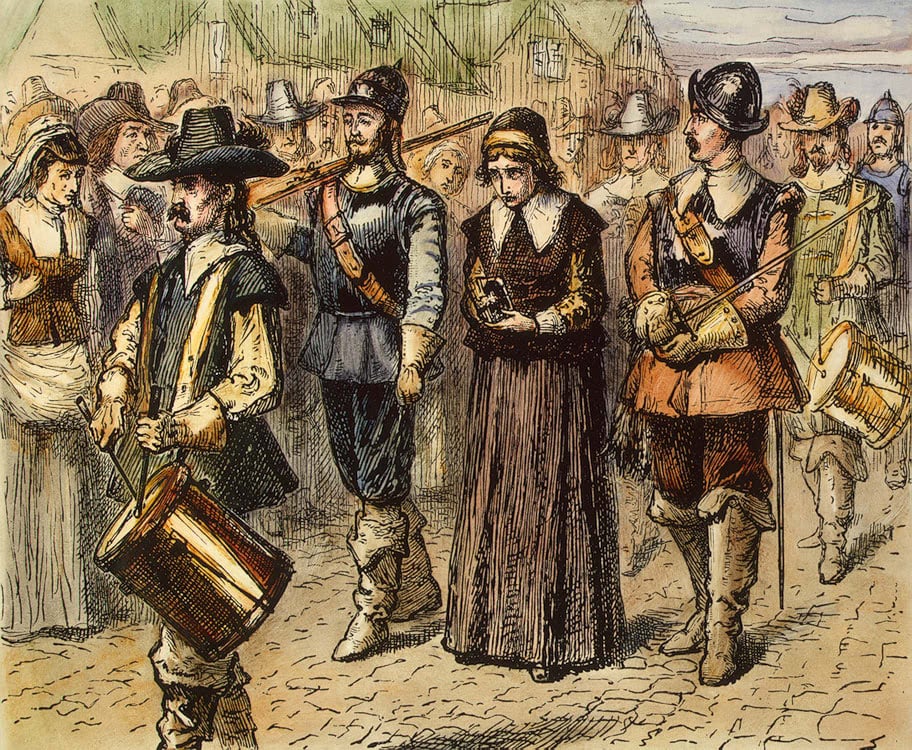
The Puritans in Massachusetts viewed the Quakers as so powerful a threat to the stability of their colony that they had passed legislation forbidding Friends within their borders upon pain of death. Mary Dyer went to Boston in the summer of 1659 after learning of the arrest of two Quaker missionaries, William Robinson and Marmaduke Stephenson, and was in turn arrested herself. The three of them were tried and convicted that fall and sent to the gallows together. Dyer watched as her two comrades were killed. Then, as the young Quaker minister Edward Burrough would later write to King Charles II, “As the Hangman was ready to turn her off, they cryed out, Stop, for she was Reprieved.”
“…and having loosed her feet, bad her come down; but she was not forward to come down, but stood still, saying, She was there willing to suffer, as her Brethren did, unless they would null their wicked Law; but they pulled her down, and a day or two after carried her by force out of Town.”
If the local authorities, uncomfortable with publicly executing a 49-year-old woman simply because of her faith, had hoped to frighten Mary Dyer away, their plan failed. Although she spent the winter outside the colony, she immediately returned to Boston in the spring, intent on forcing the Puritans to make a choice. “I came to keep Blood-guiltiness from you,” she said on the execution stand, “desiring you to repeal the unrighteous & unjust Law of Banishment upon pain of Death made against the Innocent Servants of the Lord. Therefore my Blood will be required at your hands, who wilfully (sic) do it.”
“I came to do the Will of my Father,” she told them, “and in obedience to his Will, I stand even to the Death.”
Quakers may no longer face such existential persecution from the state.
Nevertheless, doing the will of our Father—or living out our testimonies, if you prefer—can and does continue to bring Friends into conflict with the law. In the United Kingdom, London’s Metropolitan Police have forced their way into Westminster Quaker Meeting House twice in the last year to crack down on nonviolent protest groups who were meeting in the building. (By the way, none of the women arrested last year on suspicion of conspiracy to cause a public nuisance had any charges filed against them.) Though Friends did not lead either organization, the meeting had offered the groups their hospitality and safe haven, expressions of our faith which deserve vigorous defense—much as Friends in the United States have filed multiple lawsuits to protect their meetinghouses from incursions by federal agents hoping to round up “illegal aliens,” or people who match this regime’s bigoted profiles, at any rate.
What will you do when Spirit opens your ear, if it hasn’t already?
I continue to follow the callings fro God even when a few quakers shun me for my calling to minister. We need to be less critical according to our own perspective and more listening to Spirit. Rational human thought and history should never be reified over Spirit.