



I wait for the Lord; my soul waits,
and in his word I hope;
my soul waits for the Lord
more than those who watch for the morning,
more than those who watch for the morning.
(Psalm 130:5-6, New Revised Standard Version, Updated Edition)
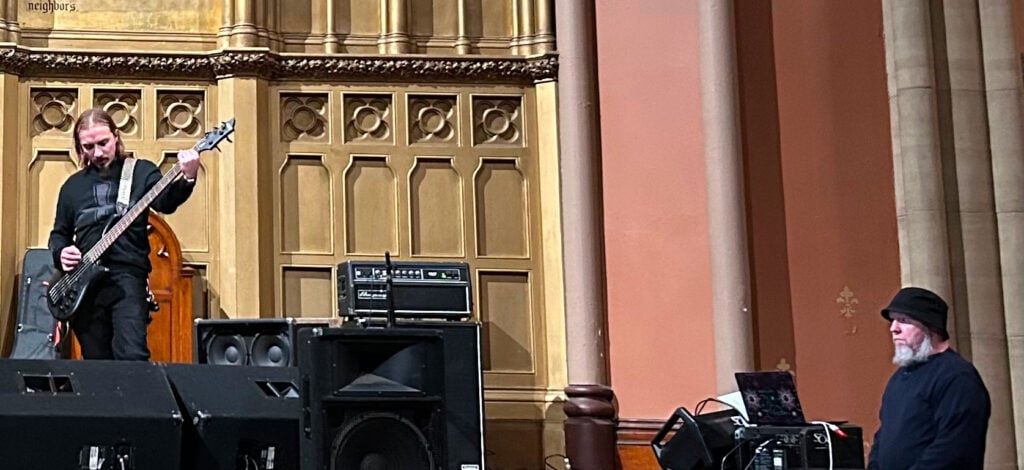
The night after the United States and Israel began bombing Iran, I went to a vigil at a church in Brooklyn.
The vigil had actually been scheduled months earlier, part of a interfaith series called Despair Sanctuary. The evenings always feature a mix of Scripture, poetry, personal essays and live performances of drone metal—low, slowly throbbing tones that sound even more ominous played inside a cavernous neo-Gothic church with most of the lights turned off. This time around, the pastor offered a reading from the book of Lamentations:
“I am one who has seen affliction
under the rod of God’s wrath;
he has driven and brought me
into darkness without any light;
against me alone he turns his hand,
again and again, all day long…” (3:1-3)
You might say—the thought certainly crossed my mind—that the people of Iran have much greater cause to feel that way at the moment than a bunch of working and middle class New Yorkers. As I’ve shared recently, though, the last decade or so has given me a deeper appreciation for how even a comparatively prosperous people might come to believe that God has abandoned them. I understand the feeling of helplessness in the face of evil forces that go to great lengths to present themselves as relentless and unstoppable. I totally get the frustration with what seems like fecklessness, if not outright cowardice or incompetence, on the part of those we might have expected to offer resistance, to serve as opposition.
I’ve also tried to keep some advice from George Fox in mind.
“Sing and rejoice, ye children of the day and of the light,” Fox told his fellow Quakers, “for the Lord is at work in this thick night of darkness that may be felt.” When he wrote that, in the fall of 1663, the restored monarchy of Charles II was continuing the persecution of Friends that had begun under the Puritans. Only a year earlier, the king and Parliament had made it illegal for Quakers to gather in groups greater than five, and Friends across the country had been arrested and imprisoned for continuing to meet for worship.
Nevertheless, Fox encouraged Friends to “be of good faith and valiant for the truth: for the truth can live in the jails.” He gave them a vision of “life and peace” to cling to against their ongoing travails:
“And truth doth flourish as the rose, and the lilies do grow amongst the thorns, and the plants atop of the hills, and upon them the lambs do skip and play. And never heed the tempests nor the storms, floods nor rains, for the seed of Christ is over all, and doth reign… And fear not the loss of the fleece, for it will grow again; and follow the lamb, if it be under the beast’s horns or under the beast’s heels; for the lamb shall have the victory over them all.”
Whether or not you accept “the seed of Christ” as such, perhaps this vision can bring you comfort as well.
After Despair Sanctuary had ended, a friend had some concerns about the extent to which the proceedings might have enabled attendees to, well, wallow in despair. I recognize the danger, for sure, but I see these evenings as an opportunity for people to come together, acknowledge our feelings, and recognize that we don’t have to face our personal and global crises alone. We can’t “solve” our despair without first confronting its existence. The narrator of Lamentations catalogs their woes at great length, but eventually arrives at a place of hope: “The steadfast love of the Lord never ceases, his mercies never come to an end.” (3:22)
The 130th Psalm expresses a similar optimism in the midst of calamity. “Out of the depths I cry to you, O Lord,” the psalmist begins, confident that God will hear his pleas. (130:1) Lately, when I think of this psalm, my mind turns to Fox and other seventeenth-century Friends, sitting in their cells, carefully nurturing their connection to the Inward Light.
I can picture them, in the hours before dawn, unable to sleep, waiting on God to bring hope and reassurance. The psalm compares such spiritual longing to the vigils of night watchmen, standing guard at a city’s walls against whatever might come out of the darkness. Just as the morning light liberates them from their posts, hope can free us from despair, and guide us back toward what Fox called “the life that was with the Father before the world began,” to follow in the footsteps of the Lamb.
The truth will survive even if we reject it.
What good comes from war?
Why destroy another fellow human, how will you end as am being reminded that the end of a matter is better than the beginning.