


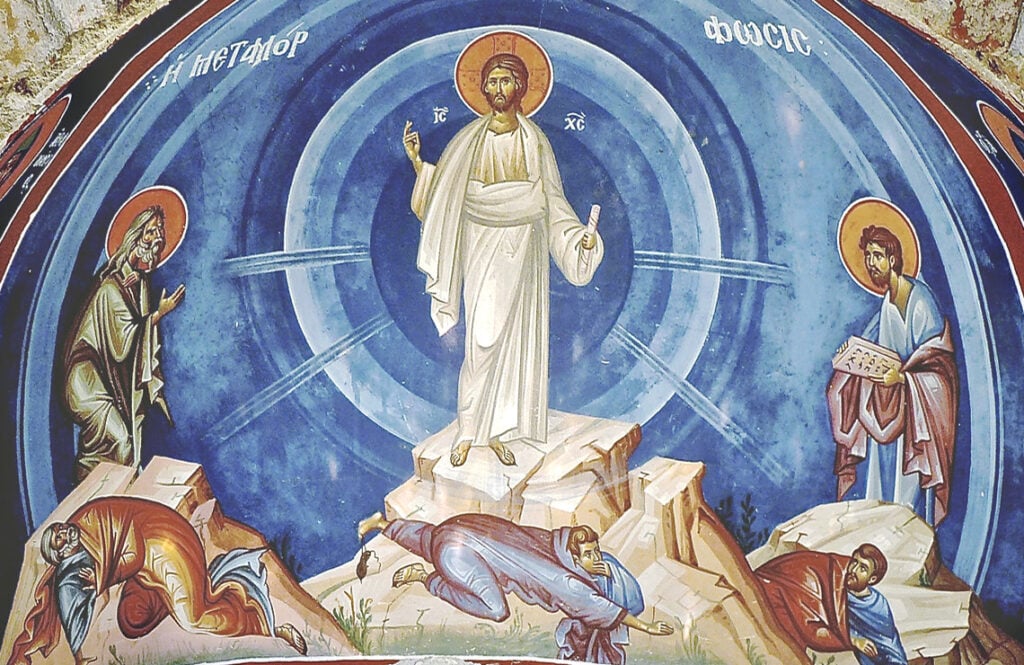
For we did not follow cleverly devised myths when we made known to you the power and coming of our Lord Jesus Christ, but we had been eyewitnesses of his majesty. For he received honor and glory from God the Father when that voice was conveyed to him by the Majestic Glory, saying, “This is my Son, my Beloved, with whom I am well pleased.” We ourselves heard this voice come from heaven, while we were with him on the holy mountain.
So we have the prophetic message more fully confirmed. You will do well to be attentive to this as to a lamp shining in a dark place, until the day dawns and the morning star rises in your hearts. First of all you must understand this, that no prophecy of scripture is a matter of one’s own interpretation, because no prophecy ever came by human will, but men and women moved by the Holy Spirit spoke from God.
(2 Peter 1:16-21, New Revised Standard Version, Updated Edition)
I met with a group of Quakers from another state over Zoom recently, before their regular meeting for worship, sharing some of my ideas about continuing revelation, and hearing from them in return. We had, I think, a really good talk. I don’t remember the last time I felt so energized that early on a First Day morning; usually, at that hour, I’m still lying in bed, a cat pinning one of my arms to the mattress.
Preparing for that conversation helped clarify my thoughts.
I reviewed some of my own messages from this newsletter, as well as rereading George Fox’s account of his first encounters with Spirit, and Robert Barclay’s explanations of the “measure of grace” in every person. I also read two popular twentieth-century Christian theologians who have a lot to say about the revelatory nature of our relationship with God.
The title of one of Dallas Willard’s most famous books, Hearing God, lays out his fundamental principle with great clarity. “People are meant to live in an ongoing conversation with God,” he wrote, “speaking and being spoken to by him.” And he did not see that conversation as one between a master and a servant, or a patron and a beneficiary: “A mere benefactor, however powerful, kind, and thoughtful, is not the same thing as a friend, [and] Jesus says, ‘I have called you friends.’”
(Quakers’ ears will surely perk up at that bit of Scripture! It may not surprise you to learn, then, that Willard worked closely with the Quaker pastor Richard Foster, who wrote the bestselling A Celebration of Discipline, for decades. Foster, for his part, considered Hearing God “the best book on divine guidance I have ever read.”)
Willard believed that, having created us, God trusted humanity enough to invite us to collaborate in the establishment of the blessed community. God wants to treat us as equal partners in that venture, and to engage with us as “persons who know one another, care about each other, and are engaged in common enterprises” do.
Oswald Chambers brought a slightly different perspective to this relationship.
In My Utmost for His Highest, Chambers sets out a series of daily reflections aimed at keeping the reader focused on serving Christ. “Tell God you are ready to be offered,” he advised, “then let the consequences be what they may.” We must open ourselves to be used to fulfill God’s plan however God sees fit, without negotiation, no matter how much it changes our lives—and we can expect that it will transform our lives profoundly.
That transformation, moreover, could happen to any one of us, at any time. “The call of God is not for the chosen few; it is for everyone,” Chambers wrote, before offering a further observation which really rings a bell with me as I strive to maintain Quaker faith and practice: “Whether or not I hear God’s call depends upon the state of my ears, and what I hear depends upon my disposition.”
Willard makes a similar point, suggesting that we will not hear clearly from God unless we have already given our relationship with God a central place in our lives: “Only our communion with God provides the appropriate context for communications between us and him.”
I think of George Fox, who spent years struggling to achieve a communion with God he fervently believed possible, frustrated over and over by the failure of religious authorities to guide him to that state. It brought him to a moment “when my hopes in all men were gone, so that I had nothing outwardly to help me.” God chose that moment to give Fox the message that became the foundation of his faith: “There is one, even Christ Jesus, that can speak to thy condition.” That revelation must have come, as the Second Epistle of Peter says, “like a lamp shining in a dark place.”
Modern Friends still seek the light of that lamp.
We have shaped our identity as Quakers by standing on the shoulders of “men and women moved by the Holy Spirit [who] spoke from God.” We gather at meetings hoping the morning star might rise in our own hearts—but we must remember that God does not confine Spirit to the meetinghouse. “Do not look for God to come in any particular way,” Oswald Chambers cautioned, “but look for Him.” You might not see God as Chambers did; you might not even call what you see God. Keep looking (and listening) anyway.
2 Peter (the Second Epistle of Peter) is a New Testament letter traditionally attributed to the Apostle Peter, but widely considered by scholars to be a pseudepigraphical work written by his followers between A.D. 60–150. When quoting Christian scripture, some exegetdical work is required. If you don’t subscribed to unavoclaism, this text is not from God, but fro “man”.
Good point, Ray, although there is still some wiggle room for Peter himself to have written this letter in the early 60s, before his crucifixion. (Although it’s true, this is not regarded as a high-probability scenario!)
More broadly, yes, authorship questions abound in the New Testament, and even in parts of the Hebrew Bible, and some weeks the message does come out in a way that explicitly acknowledges those questions. (Last week, for example, I referenced both James and the third section of Isaiah.) Other weeks, it makes more sense to jump right to the heart of the message. Maybe it’s best to think of “Peter” or “Paul” rather than Peter or Paul! Anyway, we do what we can.
As for whether the Holy Spirit moved “Peter” to write this second epistle, in some respects the jury is still out on that—the Syriac Christian church, for example, omits it (among several other letters) from their New Testament! But I’ll give “Peter” the benefit of the doubt.
God calls us in different ways, it only requires a discerning spirit to understand this. No buildings can accommodate God, only the inner most heart of a person lead to the light of God. My thoughts.
I find it exhilarating when my day begins like a squirrel finding a trail of nuts leading to a treasure trove. Sometimes I feel that I need not strive to listen so much as accept what has been spread out before me. With gratitude, of course.
Thank you for this lovely feast of the Spirit.