



In those days John the Baptist appeared in the wilderness of Judea, proclaiming, “Repent, for the kingdom of heaven has come near.”
…Then Jerusalem and all Judea and all the region around the Jordan were going out to him, and they were baptized by him in the River Jordan, confessing their sins. But when he saw many of the Pharisees and Sadducees coming for his baptism, he said to them, “You brood of vipers! Who warned you to flee from the coming wrath? Therefore, bear fruit worthy of repentance, and do not presume to say to yourselves, ‘We have Abraham as our ancestor,’ for I tell you, God is able from these stones to raise up children to Abraham. Even now the ax is lying at the root of the trees; therefore every tree that does not bear good fruit will be cut down and thrown into the fire.”
(Matthew 3:1-2,5-10, New Revised Standard Version, Updated Edition)
“I had no slight esteem of the holy scriptures,” George Fox wrote in his Journal, “but they were very precious to me, for I was in that spirit by which they were given forth, and what the Lord opened in me I later found was agreeable to them.”
Fox did not see the Hebrew Bible and the New Testament as the word of God. Rather, he recognized in Scripture’s pages the testimony of people who, like him, had firsthand experience of the Living Christ who “has come to teach his people himself.” And while he stressed the importance of sharing one’s own ministry with the world, he also understood that many of the people in seventeenth-century England he wanted to reach shared his affinity for the language of the Bible. If that language helped him make sense of his experience, it would help others as well.
In the last century or so, some Friends have worked to reframe Fox’s revelations, “assuming,” as the Quaker theological historian Douglas Gwyn writes, “that he applied Christian language to this experience simply as a matter of preference of cultural conditioning.” But any project founded on an effort to cast Fox as “the prophet of a new age of universal mysticism” will inevitably fail to fulfill the vision he and his contemporaries shared, because it will not lead people to “walk in the Spirit of Christ.”
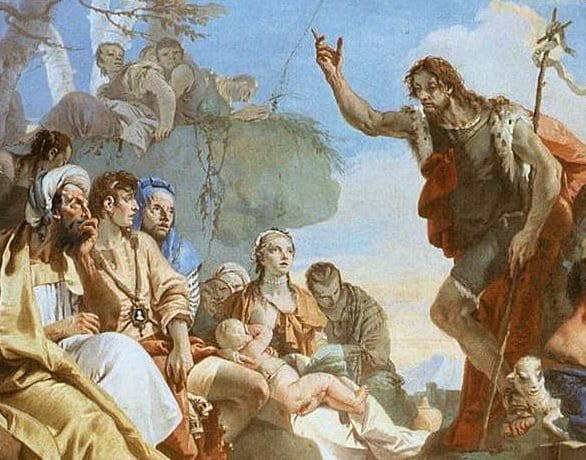
What does any of this have to do with John the Baptist?
John came forward, handpicked by God, to guide the Judaeans toward Christ’s ministry. He could feel that the time had come, that the kingdom of God had finally drawn near. The Judaeans, long oppressed by the Romans, might take great hope in such a message—but it might also frighten them, too, especially given the levels of responsibility and accountability John demanded from them.
One might claim special status as a descendant of Abraham, but John warned that such a lineage would not suffice to impress God. After all, God could raise up a new people easily enough. It didn’t matter if you held a position of spiritual authority or leadership—that alone could not save you. It might even prove a hindrance.
Instead, God wanted a people who held up their end of the covenant God had made first with Abraham, and then with Abraham’s descendants: “Hear, O Israel: The Lord is our God, the Lord alone. You shall love the Lord your God with all your heart and with all your soul and with all your might.” You couldn’t just follow along with what the priests told you, going through the motions, hoping to accumulate brownie points. You needed to believe, sincerely and utterly. You needed to feel it in your soul.
George Fox shared John the Baptist’s sense of urgency.
“It is a weighty thing to be in the work of the ministry of the Lord God, and to go forth in that,” he wrote—weighty because “it is not as a customary preaching, but it is to bring people to the end of all outward preaching.” In other words, prophetic ministry seeks to transform the audience’s lives so profoundly that they have no further need for sermons.
In a very real sense, prophetic ministry calls for the complete dismantling of the world’s current infrastructures of power and influence in order to make way for the beloved community to come. That includes religious institutions along with the political and economic citadels—Douglas Gwyn goes so far as to call it “the end of worldly religion” (italics his).
Fox had little love and less enthusiasm for the established churches of his homeland. Their emphasis on dogma and ritual had led people away from exactly the sort of direct contact with the Spirit of Christ he considered essential. As far as he could tell, the churches didn’t even try to gather people to Christ, but rather to themselves.
Why did this bother him so profoundly? Like John the Baptist, he could sense the ax at the root of the trees, ready to cut everything down. The end, in his mind, had already begun, and the Spirit of Christ was already moving through his world—not a spirit representing Christ but, as Gwyn deftly puts it, “the presence of Christ himself, come to gather and minister to his Church.”
And, again like the Baptist, Fox wanted to help others recognize and embrace that presence among them—so it could completely transform their lives as it had his.
(This message owes a substantial debt to the insights of Douglas Gwyn’s Apocalypse of the Word: The Life and Message of George Fox 1624-1691.)
Even though George Fox did not consider the Hebrew Bible and the New Testament the word of God, he must have considered any direct quotes of Jesus or the commandments given to Moses as the word of God. Therefore, portions of scripture are the word of God.
Well written…. thanks!