



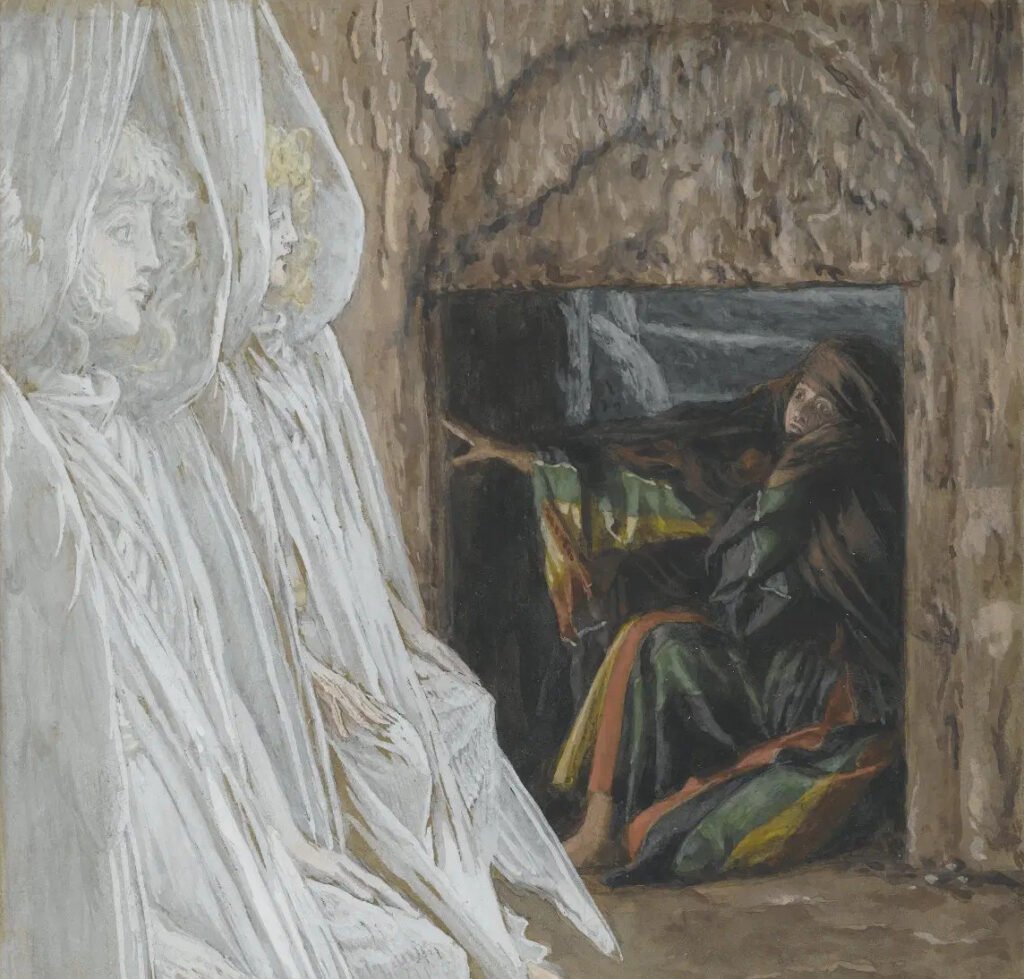
Mary stood weeping outside the tomb. As she wept, she bent over to look into the tomb, and she saw two angels in white sitting where the body of Jesus had been lying, one at the head and the other at the feet. They said to her, “Woman, why are you weeping?” She said to them, “They have taken away my Lord, and I do not know where they have laid him.” When she had said this, she turned around and saw Jesus standing there, but she did not know that it was Jesus. Jesus said to her, “Woman, why are you weeping? Whom are you looking for?” Supposing him to be the gardener, she said to him, “Sir, if you have carried him away, tell me where you have laid him, and I will take him away.” Jesus said to her, “Mary!” She turned and said to him in Hebrew, “Rabbouni!” (which means Teacher). Jesus said to her, “Do not touch me, because I have not yet ascended to the Father. But go to my brothers and say to them, ‘I am ascending to my Father and your Father, to my God and your God.’ ” Mary Magdalene went and announced to the disciples, “I have seen the Lord,” and she told them that he had said these things to her.
(John 20:11-18, New Revised Standard Version, Updated Edition)
We’ve been talking in recent messages about despair.
How do we respond when it feels like the forces of evil have triumphed over this world? Do we accept everything the principalities and powers tell us about the futility of resistance? Do we find a place to hide and mourn the world we’ve lost?
On the first Easter morning, John’s gospel tells us, Mary Magdalene went to the tomb where Jesus had been lain after his crucifixion. She found it open, his body missing. She alerted Peter and John, who came to see the empty tomb for themselves. “As yet they did not understand the scripture,” however (John 20:9), so they assumed someone had broken into the tomb and taken the body. Rattled, they returned to their hiding places.
They had good reason to lay low. When Jesus and his followers had arrived in Jerusalem a week earlier, he’d been greeted by many in the city as a liberator, the crowds openly calling on him to save them from the misery of Roman oppression.
The local religious authorities, seeking to avoid a crackdown by the Romans (and to preserve their own positions of power), had seized Jesus and delivered him to the Judaean governor, Pontius Pilate, telling him, “If this man were not a criminal, we would not have handed him over to you.” (John 18:30) All four gospels suggest that Pilate went to great lengths to avoid executing Jesus only to succumb to pressure from Jerusalem’s high priests; in John’s account, they practically accused Pilate of being soft on terrorism (19:12). But that reads more like a concerted effort by early Christians to distance themselves from the Jewish community than an actual historical account. Long story short, the Romans executed Jesus as a threat to imperial rule, and they knew his followers remained at large.
Yet while the apostles hid, Mary Magdalene stayed by the empty tomb.
She must have felt like things could not get any worse for her. She’d found a spiritual community that took women seriously—or, at least, more seriously than similar groups—only to see her mentor humiliated before suffering a gruesome public death. Now, not even his body remained for her to mourn, and two strangers are standing in the tomb, asking her why she’s crying. If she lost it at that point, it wouldn’t surprise me. I think most of us would, under similar circumstances.
In Mary’s place, exhausted by grief, we too might have failed to recognize Jesus when he showed up just outside the tomb at that moment. We might find it difficult to pull ourselves out of our despair without more direct intervention. Jesus might have had to call us by name before we realized we weren’t talking to some random stranger.
But Jesus’s resurrection at Easter reminds us that we always have a path out of despair—the path of hope. It doesn’t come easy, it doesn’t remove all the obstacles in our way. The gods of this world still wield great force, and their disciples will not surrender readily. With hope, though, we remember that we do not have to live under Empire’s thumb—we can turn back the forces of evil and establish the blessed community among us.
I don’t know if any of you participated in the recent No Kings demonstrations. I meant to meet up with a group of fellow Quakers in midtown Manhattan, but when I arrived at the statue where we’d agreed to convene, the crowds had already grown so large that I couldn’t find my Friends. After a while, I decided to make my way south down Broadway, walking beside other groups whose signs I recognized (labor unions, mostly).
The time I spent marching with other protestors felt… hopeful.
All around me, people were loudly rejecting war, and persecution, and corruption. We shouted, we chanted, at one point we even burst into song. I broke away from the march eventually, and on the subway ride home I browsed my social media and saw people having similar experiences across the United States.
I don’t want to strain the analogy here. I didn’t have a religious epiphany that Saturday afternoon, in part because I already have a great deal of hope and was mainly looking for a feeling of solidarity. Well, I got that, no question. Now we get to see if we can keep that momentum going—because Easter doesn’t end when the sun goes down on Sunday. It lasts seven full weeks, until the feast of Pentecost, and though Quakers have a historical aversion to getting caught up in religious “times and seasons,” I think we’ll find in the weeks ahead that the questions the primitive Christians faced after Jesus’s resurrection—the questions early Quakers faced as they became convinced Christ still moved among them—still hold a great deal of relevance for our lives.
Good application of this text. Thanks!