



From the wilderness of Sin the whole congregation of the Israelites journeyed by stages, as the Lord commanded. They camped at Rephidim, but there was no water for the people to drink. The people quarreled with Moses and said, “Give us water to drink.” Moses said to them, “Why do you quarrel with me? Why do you test the Lord?” But the people thirsted there for water, and the people complained against Moses and said, “Why did you bring us out of Egypt, to kill us and our children and livestock with thirst?” So Moses cried out to the Lord, “What shall I do for this people? They are almost ready to stone me.” The Lord said to Moses, “Go on ahead of the people and take some of the elders of Israel with you; take in your hand the staff with which you struck the Nile and go. I will be standing there in front of you on the rock at Horeb. Strike the rock, and water will come out of it, so that the people may drink.” Moses did so, in the sight of the elders of Israel. He called the place Massah and Meribah, because the Israelites quarreled and tested the Lord, saying, “Is the Lord among us or not?”
(Exodus 17:1-7, New Revised Standard Version, Updated Edition)
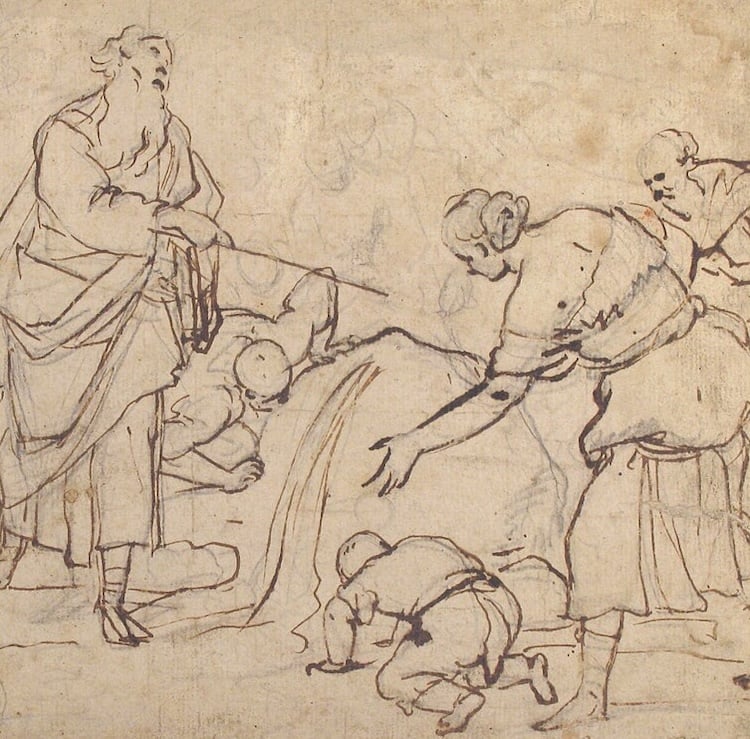
Metropolitan Museum of Art
Can I tell you how much I love this scene from Exodus?
Whenever I revisit the story of the flight from Egypt, I find myself drawn to those moments when Moses has to placate the Israelites over and over again. Nothing seems to satisfy them. Oh, you liberated us from slavery? Well, that’s great. At least Pharaoh fed us. Thanks for dragging us out into the desert to starve, Moses. Oh, the Lord is going to give us daily rations now? Wonderful. What are we supposed to wash these manna cakes down with? We’re dying of thirst here. What kind of god would treat us like this?
Moses takes all the punches—but not happily. He complains to the Lord about the situation, and not unreasonably, I think; the Israelites do seem about ready to snap, and they outnumber him quite a bit. But, once again, the Lord has everything under control. Moses follows the instructions God gives him, the people get their water, and they settle in at the base of Mount Horeb.
Horeb becomes a central location in the Israelites’ story. According to Deuteronomy, the Lord delivered the Ten Commandments there, speaking to the gathered people of Israel “out of the fire, the cloud, and the thick darkness.” The experience terrified them so deeply that they begged Moses to handle the rest of the conversation with God on his own, “then tell us everything that the Lord our God tells you, and we will listen and do it.” (5:22,27) And thus Moses received the additional terms of the covenant.
Sometimes I can really relate to Moses’s experience at Massah and Meribah.
Have you ever found yourself in a situation where you felt convinced you knew what needed to be done, and that things would go great if everyone else around you would just get with the program already? I imagine Moses felt like that a lot in the desert (although the record often suggests that he had just as much anxiety as the rest of the Israelites). I felt like that pretty frequently as a younger man, and I can still slip into that mode today.
As I’ve gotten older, though, I’ve become a bit more sympathetic to the Israelites. In the last decade, especially, I’ve developed a better understanding of how a people might come to wonder whether God had abandoned them. Personally, I believe God cares about us as much as ever… with all the ambiguity and uncertainty you might read into that. From the evidence of Scripture, however, I can infer that God continually hopes for us to rise to the occasion on our own initiative. God gave us the blueprint for a blessed community, and will help us as we work toward it, but we still have to put that work in.
But when people become convinced God has abandoned them, they usually decide that they need to fend for themselves. And “fending for ourselves” always implies “screw the rest of you,” which inevitably leads to “we need to keep you down, or else you’ll try to get your hands on our stuff.” The theologian Walter Brueggemann called that “the royal consciousness,” and it leads inexorably to the rise of Empire.
The prophetic imagination of the earliest Quakers offers an alternative.
Friends in seventeenth-century England had as much reason as we do today to look at the world around them and wonder if God had moved on. Instead of deciding that God was no longer paying attention to them, though, they reached the opposite conclusion: The majority of people no longer paid attention to God, because the religious institutions of the day no longer cultivated true spiritual formation. People needed to relearn how to listen for, as George Fox said, the one who could speak to their condition. “The Lord of Heaven and earth we found to be near at hand,” Francis Howgill, a contemporary of Fox, wrote of that relearning, “as we waited upon him in pure silence, our minds out of all things, his heavenly presence appeared in our assemblies…”
“The Kingdom of Heaven did gather us and catch us all, as in a net, and his heavenly power at one time drew many hundreds to land. We came to know a place to stand in and what to wait in; and the Lord appeared daily to us, to our astonishment, amazement and great admiration…And from that day forward, our hearts were knit unto the Lord and one unto another in true and fervent love, in the covenant of Life with God.”
Does your meeting make you feel like that, for whatever version of “God” you hold in your heart and mind?
The article by Ron Hogan , “Is the Lord Among Us or Not?”, was a powerful and helpful read. I really like how Hogan connects the text to present day concerns. The article also speaks to the hard work of leadership. Thank you for this inspiring message!