


Consider your own call, brothers and sisters: not many of you were wise by human standards, not many were powerful, not many were of noble birth. But God chose what is foolish in the world to shame the wise; God chose what is weak in the world to shame the strong; God chose what is low and despised in the world, things that are not, to abolish things that are, so that no one might boast in the presence of God.
(1 Corinthians 1:26-29, New Revised Standard Version, Updated Edition)
Quakers love talking about “that of God in everyone.”
The expression goes back all the way to George Fox. In a 1656 letter to “Friends in the Ministry,” Fox called upon fellow Quakers to “be a terror to all the adversaries of God, and a dread, answering that of God in them all, spreading the Truth abroad, awakening the witness, confounding deceit, gathering up out of transgression into the life, the covenant of light and peace with God.”
Over the centuries, Friends have read that phrase in many different ways. Robert Barclay, for example, said in his Apology for the True Christian Divinity that God grants everyone the opportunity to embrace salvation. “For this end,” Barclay wrote, “God hath communicated and given unto every man a measure of the Light of his own Son, a measure of grace, or a measure of the Spirit, which the Scripture expresses by several names.”
Among other verses, he points the reader to Jesus’s explanation of the parable of the sower, specifically Matthew 13:19: “When anyone hears the word of the kingdom and does not understand it, the evil one comes and snatches away what is sown in the heart.” Another early Friend, Isaac Penington, had written more than a decade earlier about “the seed which God sows in the heart.” He encouraged Friends to “let that [seed] grow in thee, and be in thee, and breathe in thee, and act in thee.” If they did so, he promised: “thou shalt find by sweet experience that the Lord knows that, and loves and owns that, and will lead it to the inheritance of life.”
For those with a Christ-centered faith, this all sounds great. But I want to talk about another, equally important aspect to “that of God in everyone.”
To me, “that of God in everyone” suggests a radical equality among all people.
First, God intends for everyone to take part in “the covenant of light and peace with God,” and, to the best of their abilities, Friends have an obligation to help everyone do so. People might learn of the promise of the blessed community and reject the good news; people do all sorts of foolish things. But Quakers have no right to appoint themselves as gatekeepers, to treat the blessed community as a special club from which they can preemptively exclude those they consider “unsuitable.” If someone demonstrates a willingness to follow the Inward Light’s beacon, we must do what we can, as individuals and as meetings, to help them along that path.
That doesn’t mean that meetings have to automatically accept everyone who wants to become a member. But it does mean that Friends should work with every seeker who comes to them—and take a sincere interest in their spiritual formation, wherever that process may lead.
Second, “God shows no partiality,” as Peter told the Gentiles (Acts 10:34-35), “but in every people anyone who fears him and practices righteousness is acceptable to him.” Quakers knew this verse well, but in a different translation: “God is no respecter of persons.” Personally, I prefer that version. I think it speaks to something much heftier than a lack of partiality. It reminds us that the blessed community’s covenant nullifies and voids every social hierarchy around which humans organize themselves, every system that places some people above others.
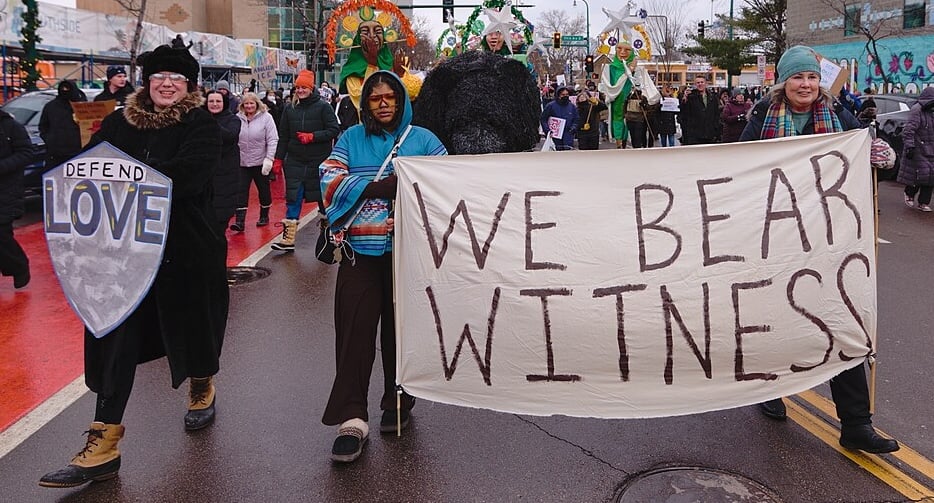
The blessed community embraces those scorned by the rulers of this world.
You shouldn’t have any problem recognizing the “low and despised” in today’s society. In the United States, the current ruling regime makes no secret of its contempt for the poor, for immigrants, for people of color, for queer people in general and transgender people in particular. (I say this as an American citizen, but I’ll add: Other nations—like, say, England—should not rush to pat themselves on the back on any of these fronts.)
Every person rejected by the elites, though, has that of God in them. Every outcast has a home in the blessed community. Every “loser” has the potential to contribute to the blessed community’s success. And these truths do strike terror in all the adversaries of God.
“We live in a world… that is governed by strength, that is governed by force, that is governed by power,” the White House deputy chief of staff, Stephen Miller, claimed in a recent interview. “These are the iron laws of the world that have existed since the beginning of time.” People like Miller like to repeat such stories to soothe themselves—because, like Herod at the time of Jesus’s birth, they live in fear of the world to come, the world where all their power counts for nothing. And, like Herod, they will flood the streets of their own cities with armed minions, ordering them to strike at anyone who challenges their authority, even by simply existing.
But, as Paul said, “God’s foolishness is wiser than human wisdom, and God’s weakness is stronger than human strength.” (1 Corinthians 1:25) As Friends, we dedicate ourselves to spreading that truth, awakening witnesses whenever and wherever we can, and laying the foundation for the downfall of all wicked empires.
I am in of those “… transgender people in particular.” Even though I am apart of an independent catholic church, the ratcheting up of violence against immigrants /protestors, and the rhetoric against the transgender community by our government has made me in like measure find evolving solace in the Quakers. I find /am finding immense comfort in the biblical words and philosophy shared in the Friends Journal. I have explored Quakerism and visited one Friend’s twice before several years ago. Now, I find myself returning to exploration especially in these dark days. Thank you.
But if there is “that of God in everyone” then there is that of God in Donald Trump, in Stephen Miller, in Jonathan Ross etc. What does that mean in terms of how we as Quakers should think and act? There is that of God in Herod and al the “elites.” Isn’t there? God doesn’t choose one over the other. God makes the rain to fall on the just and unjust equally and so too with God’s love. How do we reconcile that with Trump et all.
It’s a great question, John! First and foremost, I think, we can bear witness, even defiant witness, without resorting to violence, “speaking truth to power” firmly and laying the groundwork for the Inward Light to call people into repentance. But then how do we handle rejection? Jesus had some thoughts about that: “And when ye come into an house, salute it. And if the house be worthy, let your peace come upon it: but if it be not worthy, let your peace return to you. And whosoever shall not receive you, nor hear your words, when ye depart out of that house or city, shake off the dust of your feet.”
We don’t like to think about cutting people off like that so much—and not just because few of us anymore live the kind of itinerant lifestyle Jesus was describing for his apostles! But sometimes we may have to acknowledge that people have made their investment in Empire, and leave them to it… and let the Inward Light catch up to them in its own time.
I always feel some hesitation when I hear “that of God in everyone” quoted. I wonder if it is possibly not being used as George Fox meant it to be used.
God gave us (humans) two great gifts: the ability to receive God’s personal love (as distinct from God’s principled love that imbues all God’s creations), and the gift of free will.
The gift of free will dictates that we can only receive God’s personal love (with its many associated benefits since we are receiving a part of God) when we earnestly and sincerely desire it, not just as a casual request or as part of a ritual like baptism; it is never given without our active involvement.
God created humans, and only humans, to have souls, as God is Soul, and this the way in which we are in God’s image, but it takes our conscious choice, our soul-based desire, to receive some of God’s substance in the form of God’s personal love, which has the additional benefit of transforming our souls, bit by bit, to come to love as God loves.
So when I hear ‘that of God within us,’ it sounds to me like we are assuming we have all received God’s personal love, and the risk here is to spread the belief that this is a token gesture easily made, whereas my experience is that it is not that at all, that it requires a deep longing and sincerity and willingness to see oneself as God sees one, painful as that might be. In contrast, I believe that George Fox was referring to our soul, the seat of our unique God-given personality, desires, emotions, memories.
Seeing another’s soul, rather than all their failings, is really important, but it having a part of God will not always be the case. Because receiving this gift of God’s personal love on an ongoing basis is vital to our future deepest happiness, I’m uneasy about the current use that I’ve noticed of the term “that of God within us,” because of my concern that it reinforces the common view that we are already part of God, through no exercise of our own will – whereas God wants us to freely choose a connection and waits for us to make the first move.