


For he delivers the needy when they call,
the poor and those who have no helper.
He has pity on the weak and the needy
and saves the lives of the needy.
From oppression and violence he redeems their life,
and precious is their blood in his sight.
(Psalm 72:12-14, New Revised Standard Version, Updated Edition)
During the lull between Christmas and New Year’s, I took the opportunity to catch up with some of the religious newsletters I follow, which cover a wide range of spiritual traditions.
The feminist neopagan activist Starhawk offered a particularly seasonal reflection. “The pleas to put Christ back into Christmas generally leave me cold, and the attempts to make the U.S. a Christian nation leave me somewhere between pissed off and terrified,” she wrote—and yet, “I can’t help but think what it would be like if America became a truly Christian country. Not MAGA Christian or Christian Nationalist, but a country committed to following Christ’s actual teachings.”
Friends can probably anticipate where she’s going with this message.
She begins by imagining millionaires and billionaires renouncing their wealth and lining up for baptism, but quickly moves from entertaining fantasies to practical objectives. “If Jesus were here today, wouldn’t he be hanging out in the homeless encampments and giving aid and comfort to refugees?” she asks. Wouldn’t improving the quality of life for everyone become the nation’s top priority? Wouldn’t followers of Jesus want to make sure that all people, from the youngest to the eldest, had access to food and shelter, education and health care?
“And finally,” she says, “if we really believed in the Prince of Peace, we’d stop seeing war as the ultimate arbiter of every conflict, the final answer to every unsolved dilemma… and instead look to address the root causes of instability and insecurity by demanding equity and justice.”
All of this resonates neatly with SPICES, a reworking of several elements of Quaker testimony into language compatible with the ideals of contemporary secular liberalism: Simplicity, Peace, Integrity, Community, Equality, and Stewardship. But while such ideals may align with the core principles of Christ’s teachings, as understood by generations of Friends, Jesus did not invent that agenda out of thin air. He was reacquainting his listeners with the terms of a covenant that God had first offered centuries before, to love God and to love their neighbors as themselves.
The 72nd Psalm outlines what a community grounded in such a covenant might look like.
This psalm offers praises for a king who acts in accordance with a divine sense of justice and righteousness. “May he defend the cause of the poor of the people, give deliverance to the needy, and crush the oppressor,” the psalmist declares (72:4). Care for the needy features prominently in this vision of good governance: “He delivers the needy… he has pity on the weak and the needy, and saves the lives of the needy.”
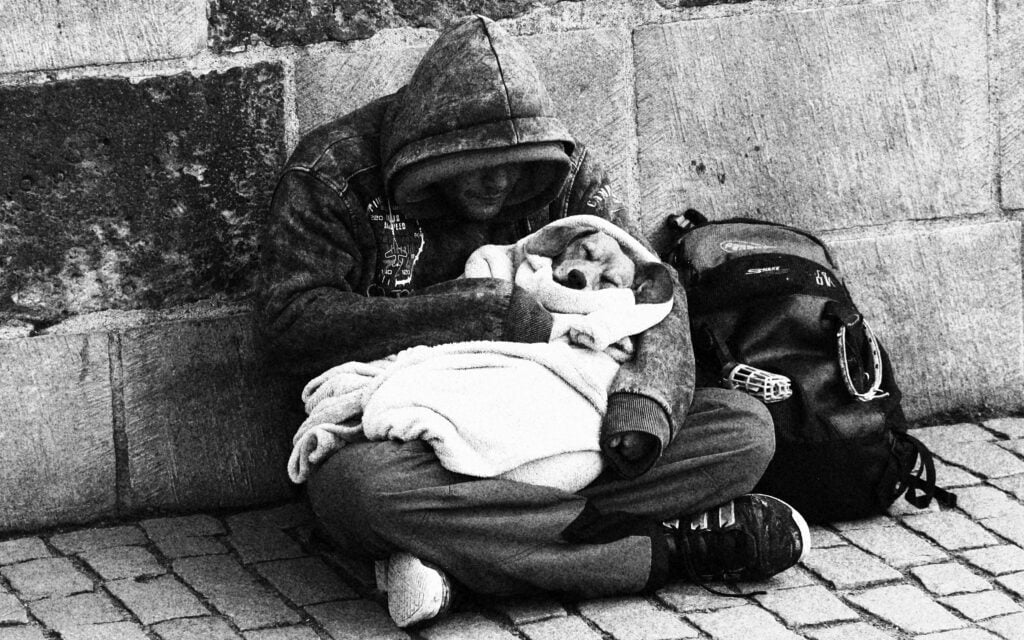
As the footnotes from the NIV Application Bible accompanying this passage explain, “the king has the task of defending those who are unable to defend themselves in society.” A leader assumes power not for himself, not for a small inner circle, but for the benefit of all. In the society this psalm envisions, phrases like “no child left behind” hold real meaning, and the people can expect to see such promises fulfilled.
Rulers don’t always live up to such lofty ideals, of course—and God had, in fact, warned Israel not to place its faith in human rulers. “These will be the ways of the king who will reign over you,” God had Samuel tell the Israelites:
“He will take your sons and appoint them to his chariots and to be his horsemen… He will take your daughters to be perfumers and cooks and bakers. He will take the best of your fields and vineyards and olive orchards… one-tenth of your grain and of your vineyards… He will take your male and female slaves and the best of your cattle and donkeys and put them to his work. He will take one-tenth of your flocks, and you shall be his slaves.” (1 Samuel 8:11-17)
And, God says, when that day comes, we will have nobody to blame but ourselves, for allowing such a man to rule over us.
Now, I don’t imagine more than a handful of the millions who participated in the “No Kings” protests across the United States this summer and autumn had that warning in mind. (Though some may have!) Most folks likely connected with the deliberate invocation of the American Revolution, and I don’t have any complaints about that. Between Samuel’s warning and the psalmist’s hope, however, I sense a reminder of the promise that people who come together in a spirit of blessed community—who, as we’ll discuss next week, bear God’s law within their hearts—have what it takes to bring themselves to peaceful and abundant order.
We want to hear from you, not an AI! Please be thoughtful and use your own words. Comments on Friendsjournal.org may be used in the Forum of the print magazine and may be edited for length and clarity.