


Jesus began to speak to the crowds about John: “What did you go out into the wilderness to look at? A reed shaken by the wind? What, then, did you go out to see? Someone dressed in soft robes? Look, those who wear soft robes are in royal palaces. What, then, did you go out to see? A prophet? Yes, I tell you, and more than a prophet…”
(Matthew 11:7-9, New Revised Standard Version, Updated Edition)
What drew people to John the Baptist?
Why did they venture out of Jerusalem and other towns in Judea to hear John speak? Quite simply, they came because he had a message that, to borrow a turn of phrase from George Fox, spoke to their condition. They chafed under the rule of a foreign oppressor, and John declared that God would soon come to liberate them—if they repented of the sinful behavior that had led to the withdrawal of God’s favor and left them vulnerable to conquest in the first place.
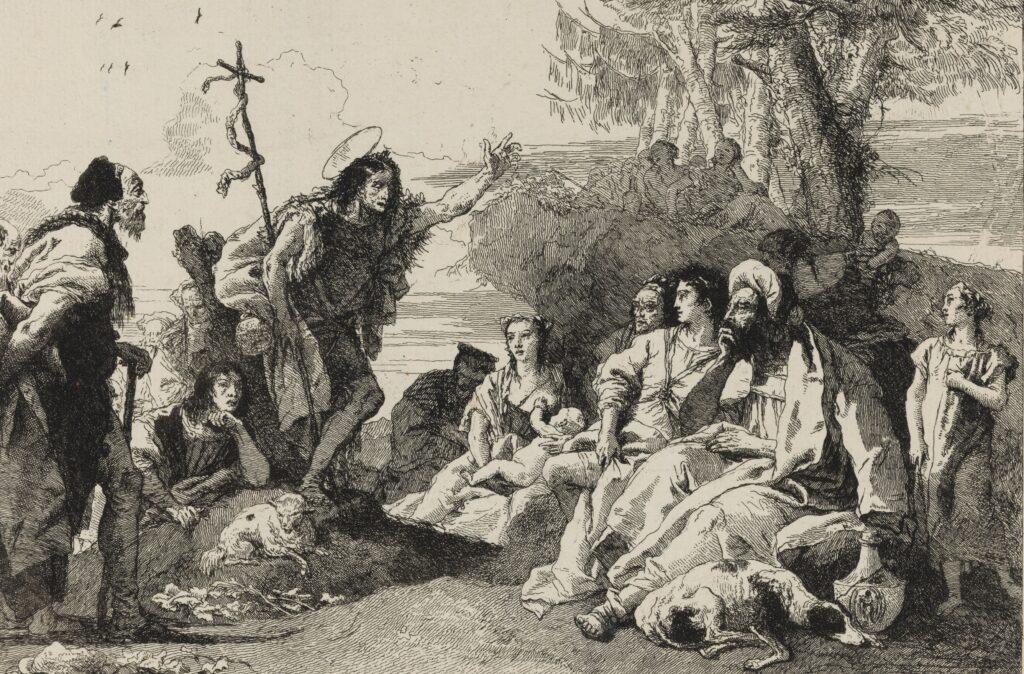
As Jesus observes in the gospel reading above, John deliberately placed himself at the outskirts of society, forcing people to step out of their comfort zones if they wanted to hear him. Some people would undoubtedly hear him speak and consider their day wasted. But we don’t read about them; we read about the people who took John’s words to heart, accepted his baptism, and awaited the kingdom of God, the setting right of everything.
Jesus spoke to the crowds soon after Herod had thrown John the Baptist into prison in an effort to silence his revolutionary call. They must have wondered how this situation could possibly resolve itself in a way that would vindicate John’s promise. They had believed, and now they surely would have felt despair, seeing their leader brought low by the very forces he had called upon them to resist.
Jesus encouraged them not to abandon their faith, assuring them of John’s status as “the one about whom it is written, ‘See, I am sending my messenger ahead of you, who will prepare your way before you.’” And that meant he was assuring them of his status as the redeemer John foretold.
Sixteen centuries later, George Fox would echo John’s summons.
“The spirit bids, come!” Fox wrote in one of his many tracts. “The call is away from all false worships and gods and from all inventions and dead works to serve the living God now. The call is to repentance and to the amendment of life, whereby righteousness may be brought forth to go throughout the earth.”
Fox also emulated John’s decision to stand at the fringes of “polite” society, although rather than make the people come to him, Fox took up the life on an itinerant preacher, making his way across England (and, eventually, to the colonies in North America). Wherever he went, he called people to what the Quaker historian Douglas Gwyn, in Apocalypse of the Word, describes as “revolutionary spiritual warfare.”
In fighting the Lamb’s War, however, Friends did not rely upon physical force. Shortly after the restoration of Charles II to the British throne, when the loyalty of the Quakers came into question, a group of Friends (including Fox) issued a statement to assert not just neutrality, but rejection of conflict altogether:
“All bloody principles and practices, we, as to our own particulars, do utterly deny, with all outward wars and strife and fightings with outward weapons, for any end or under any pretence whatsoever. And this is our testimony to the whole world.”
That peaceableness came with a cost. “From the days of John the Baptist until now, the kingdom of heaven has suffered violence,” Jesus had said, “and violent people take it by force.” (Matthew 11:12) The situation had not changed much in Fox’s time, and many Quakers suffered as John and Jesus had suffered, as the gods of this world sought to stifle their good news.
And what about today?
Imagine yourself in a crowd listening to John the Baptist in first-century Judea, or to George Fox in seventeenth-century England. Why did you go? What did you hope to get out of the experience? Would hearing them lead you to repentance? How would you live your life differently if it did?
Now ask yourself the same questions about attending meeting for worship on a First Day morning. (If you don’t go to meeting, you can still pretend!) Don’t worry about whether you have a John the Baptist or a George Fox in your midst. Just focus on the messages that emerge from those gathered in waiting worship.
Do the messages in your meeting lead you to serve the living God now? Do they invite you to change your life so righteousness may be brought forth to go throughout the earth? Now ask yourself again: Do they really? And have you followed through on them?
If you could answer any of those questions with a No, what exactly have you been coming out to see? And has it actually fulfilled you?
We want to hear from you, not an AI! Please be thoughtful and use your own words. Comments on Friendsjournal.org may be used in the Forum of the print magazine and may be edited for length and clarity.