During the
half-hour hearing, the justices pummeled the lawyers with questions about the
purpose of the state's marriage laws, the role of the court, and an earlier
court decision allowing gay couples to adopt children. One justice questioned
whether legalizing gay marriage would also allow polygamy.
Justice
Roderick Ireland questioned Bonauto about arguments from state lawyers who say
the question of sanctioning same-sex marriage belongs with legislators.
''Why do you
think that this is an issue that we should decide?'' Ireland asked.
''I think it's
an issue this court should decide because it's the institutional obligation of
this court to decide constitutional issues,'' Bonauto answered.
Justice Martha
Sosman questioned whether allowing same-sex marriage would also allow polygamy.
''What would the difference be?'' she asked.
Bonauto said
that neither the Legislature nor the state's highest court has ever suggested
that marriage should be made up of more than two people.
The couples'
lawyer and other same-sex marriage supporters argue that the state
constitution's protections of equality and liberty allow citizens to choose
whom they want to marry.
The state
attorney general's office, which is defending the state's right to deny
marriage licenses to same-sex couples, argues that the state constitution
doesn't provide such rights.
Yesterday,
Justice John Greaney asked Assistant Attorney General Judith Yogman whether she
saw the same paradox he did in allowing same-sex couples to adopt children, but
not to marry each other. ''Are those ideas somewhat at odds?'' he asked.
''Not at all,
your honor,'' Yogman said. ''Adoption is one thing. Marriage has many other
responsibilities and benefits associated with it other than child-rearing.''
Did she agree,
he asked, that the modern definition of family has ''gone far beyond the notion
of two heterosexual people married and having children?''
Yes, Yogman
said, but that still didn't establish a constitutional right to same-sex
marriage.
The justices'
ruling will probably not come down for at least several months.
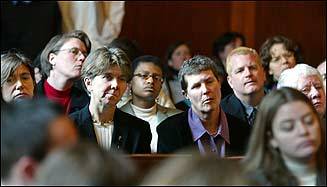
More than 200
people turned out to hear the arguments, packing the courtroom and spilling
over into the hallway. The morning unfolded calmly, without protests or
pickets.
The case has
attracted national attention, with dozens of groups on both sides of the issue
weighing in with friend-of-the-court briefs. Some religious groups argued that
same-sex marriage is immoral; local and state bar associations supported the
seven couples; and law professors turned in legal briefs on both sides of the
debate.
The state that
has come closest to same-sex marriage is Vermont. After a similar legal case
there, the Vermont Supreme Court ruled in 1999 that the state constitution
guarantees gay and lesbian couples the same benefits and protections given to
heterosexual couples. The state's Legislature, faced with a choice of allowing
gay marriage or a similar domestic partnership, created civil unions that bring
many of the same benefits of marriage but aren't recognized beyond that state.
The
Massachusetts case began two years ago, when the seven couples sought marriage
licenses and were rejected. They lost their first court battle, when Suffolk
Superior Court Judge Thomas E. Connolly dismissed their case, saying the
Legislature should decide the question. Bearing children has long been
considered central to marriage, and same-sex couples alone cannot create
children, he wrote in his decision.
The seven
couples appealed, and the SJC agreed to hear the case. The case will determine
only whether the state sanctions civil same-sex marriage; if the seven couples
prevail, churches would still decide whether to marry same-sex couples.
For supporters
of same-sex marriage, yesterday was a day of hope. After the arguments, some
supporters hugged each other and Bonauto's voice trembled when she spoke to
reporters.
''This is a
historic day in Massachusetts,'' she said, as supporters cheered and clapped.
''The seven plaintiff couples had their day in court. Their families are equal
families in this Commonwealth. They should have the same rights as all other
families enjoy.''
The 2000
Census found more than 17,000 families in Massachusetts living in same-sex
households, she said. As Bonauto spoke, the seven same-sex couples stood behind
her.
''For 32
years, I've loved Gloria and wanted to marry her,'' said Linda Davies of
Orleans, about her partner, Gloria Bailey. ''And I think after today, I'll
finally get to do that.''
Gina Smith and
Heidi Norton of Northampton, two other plaintiffs in the lawsuit, say they
always try to keep with them copies of their health care proxies, legal papers
that give each the right to make decisions for the other if one of them should
become ill or incapacitated. Otherwise, hospitals could refuse them access to
each other since the two women, the parents of two young boys, are not legally related.
''But even
that big stack of documents,'' Norton said, ''does not feel like it has the
weight of a single word: marriage.''
Kathleen Burge
can be reached at [email protected].
This story ran
on page A1 of the Boston Globe on 3/5/2003.
� Copyright
2003 Globe Newspaper Company.