 Upper School Upper School
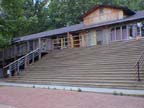
The Carolina Friends Upper School is located in a wooded setting in the Friends School Road campus. The original Upper School building, a beautiful log structure, includes a large room for group meetings and activities, classroom and office space, a student lounge, a school store, and spacious decks for outdoor gatherings. Two new buildings shared with the Middle School contain a library, an art studio, two science laboratories, computer rooms, and additional classroom space. Nearby is a woodworking shop that was constructed by students. The nature trail, sports pavillion, climbing tower, athletic fields, gymnasium, and the Center for Performing Arts, are shared with other units of the school.
PHILOSOPHY OF EDUCATION
The primary concern of the Upper School is to help students aged fourteen through eighteen face important academic and social challenges in a friendly and supportive atmosphere. Based on the Quaker belief in the fundamental worth of the individual, the School's philosophy is a vital spirit manifested in every part of its program. The School affirms that the process of learning is as important as its product. Thus the School actively seeks a diverse group of students from different national, racial, social and economic backgrounds, whose various talents and capabilities are woven each year into the School's program. The faculty is dedicated to bringing out the multi-faceted potential in every individual with care and respect. Every element of the School is designed to help students not only to accumulate knowledge but also to apply that knowledge with thoughtfulness and responsibility. The Upper School's uniqueness was recognized by its 1984 citation as one of 60 "Exemplary Private Schools" in a nationwide study by the U.S. Department of Education.
THE UPPER SCHOOL PROGRAM
The School's commitment to individual growth and advancement results in the elimination of formal grade levels, though the Upper School generally corresponds to the 9th through 12th grades of a conventional system. A student population of approximately 150 keeps the student/staff ratio low (about ten to one), and provides the thorough attention and individual guidance necessary for a program which emphasizes personal responsibility and growth.
Curriculum
The curriculum provides an unusually broad array of courses designed to fulfill the School's rigorous graduation requirements while stimulating academic, social and emotional growth. The School operates on a trimester system with three 11-week terms per year. Graduation requirements (90 credits) include 12 terms of language arts, 9 terms of mathematics, 9 terms of history (including U.S. History), 6 terms of science (biological and physical), 3 terms of foreign language or culture, 8 terms of cultural arts, 8 terms of physical education, 8 terms of service to the School or community, 1 term of Human Sexuality, competency in computer science, and 22 electives in any of the above areas.
Students arrange their own schedules under the close supervision and guidance of advisors. Everyone is encouraged to choose classes not merely to satisfy requirements but also to explore and experiment in new areas. Thus the range of choices offered includes such courses as Creativity and Self-Discovery, Native American Cultures, World Religions, and Field Biology, as well as Chemistry, Shakespeare, European History, and Calculus. Advanced students also are encouraged to develop their own programs of independent study under faculty supervision. Each year, some Upper School students take courses at Duke University or the University of North Carolina at Chapel Hill.
Athletics and cultural arts are both required elements of the curriculum. A variety of individual and coeducational team sports are offered, including softball, soccer, cross-country, basketball, baseball, biking, aerobics, volleyball and frisbee. Some students also participate in extracurricular soccer, volleyball and basketball teams, which compete with other area schools. The cultural arts curriculum includes a multi-level dance program as well as courses in drama, choral and instrumental music, masks and myths, ceramics, painting, drawing, photography, and basketweaving. Several dramatic, musical, and dance performances take place each year.
Another important aspect of the Upper School curriculum is required service to the community. Students may fulfill this requirement by doing construction or maintenance work on school buildings and grounds, tutoring students in other units of the School, working in the library, serving as a teacher's aide, or helping to create the school yearbook. Students may also arrange to work outside the School in local nursing homes or other service institutions to earn service credit. At the end of the day, all students and staff are responsible for cleaning the building and grounds. The service requirement strengthens each individual's sense of ability and self-worth while increasing the cohesiveness of the entire School community.
Daily Schedule
Most Upper School classes meet for 45 minutes four times a week. Longer time slots are available for those classes which require more uninterrupted time, such as art, dance, and drama classes. Classes of all disciplines are distributed throughout the day, to give students greater choice in scheduling a daily balance of analytical, physical and creative effort. Each morning begins with advisee group meetings in individual homerooms; staff and students also have a silent meeting period together on Wednesday afternoons. The entire Upper School meets together one afternoon period a week, and more often for special events. Special events and activities are organized by staff and by students on the Clerks Committee, a governance group open to any student.
Mini-Sessions
At certain times during the year, the regular class schedule is supplemented by two- to eleven-day Mini-Sessions. There are three main functions of the Mini-Session program: service to the broader community, intensive learning and self-education, and enhancement of the School community. In the fall there is an all-school, in-depth study of a current issue, such as imprisonment and its alternatives, nuclear disarmament, communication skills, or gender roles in society. These programs are planned by staff and students together, and include field trips, panel discussions, lectures, and workshops. During the winter the entire Upper School gets involved in service projects such as winterizing the homes of needy people in the community, splitting wood, or working in local nursing homes, preschools, hospitals, or soup kitchens. These service projects reflect the School's belief that education should be used in service to others.
Each year, after the completion of final examinations, Upper School students and staff spend approximately two weeks in alternative courses of study. Staff-led classes and trips comprise the bulk of the program, yet students are also encouraged to develop an independent study course or to arrange an internship during this time. This program is paid for through regular tuition, with the expectation that each student will be involved in two "off-campus" programs (trips) in a four-year period.The other two years would involve an "on-campus" program, an independent study, or an internship. Each student is guaranteed a place on two "off-campus" programs though is not required to utilize both of these opportunities.
Advisor/Advisee System
At the heart of the School's commitment to the individual is the advisor/advisee system. Each student chooses one staff member as an advisor. Each staff member advises about ten students who, together, constitute a homeroom. The advisor helps to design each advisee's schedule, acts as a personal counselor, and serves as the primary link between the School community and the student's family. Advisors consult frequently with parents and are responsible for writing the summary evaluation of the student at the end of the year. Time is set aside in the schedule for advisor/advisee consultation or group outings. The special relationship between advisors and advisees contributes substantially to the School's atmosphere of trust and affection.
EVALUATION
At Carolina Friends School, evaluation is part of the learning process rather than the assignment of a grade or number at the end of term. It is an element of education to which much time, thought, and care is given. As a result, the School's evaluation system is personal, comprehensive, and highly effective. Each trimester the student receives from every teacher a written evaluation which provides both student and parent with a specific, detailed account of the student's performance in class. These end-of-term reports review the student's overall progress, including achievement on tests and papers, self-direction, contributions to class, and growth of understanding. Reports also direct attention to areas that need improvement and suggest appropriate courses of study. Students earn credit or no credit for each course. Conferences are formally scheduled between the student's advisor and parents to discuss these written evaluations, but contact between teachers and family is rarely limited to these periods. A final, end-of-year report, written by the advisor, is sent home in June. This report summarizes the student's growth and achievement for the year and offers recommendations for the following year.
FACULTY
There are fifteen advisors in the Upper School and several additional teachers who are shared with other units of the School. The faculty is diverse in background and highly qualified; more than two-thirds have advanced degrees. Members of the arts faculty are practicing professionals who perform and exhibit in the community. The School is fortunate to attract and retain individuals who are deeply committed to teaching as an art, as a profession, and as an opportunity to nurture students as well as to share the rewards of their particular discipline.
AFTER GRADUATION
Most graduates of Carolina Friends School go on to attend four-year colleges. The personalized curriculum, however, provides an excellent program for college-bound and non-college-bound students alike. The range of colleges attended by graduates has been wide: from large state universities to small, private colleges, Ivy League institutions, and professional arts or technical schools. CFS has been graduating high school students since 1974.
ADMISSION
Applications for admission are made through the School's main office and are received beginning in September. The application process includes a School tour, an observational visit, and an interview. Applications that are received prior to February 1 are considered as a group in the first round of admissions decisions, which are made in early April. Tuition aid is available for students who could not otherwise attend the School. Tuition aid forms are available at the main office.
As a reflection of its calling and philosophy, Carolina Friends School actively seeks to build a community of staff, students, and families of diverse backgrounds. CFS does not discriminate on the basis of race, religion, color, gender, sexual orientation, socio-economic background, physical handicap, or national or ethnic origin in the administration of its policies and programs.
Revised November, 2000
 Back to CFS Main Page