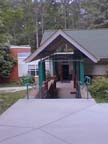
 Lower School
 Lower School
The Lower School, located on the main campus of Carolina Friends School, meets the growing and learning needs of children ages six through ten. Rooms are open, colorful, and designed for maximum flexibility, providing space for both independent study and group learning as well as for play. The large playground invites a variety of creative play activities, while the School's creek and wooded, rural setting offer an ideal environment for exploration and nature study.
PHILOSOPHY OF EDUCATION
The philosophy of the Lower School is rooted both in the principles of
the Religious Society of Friends (Quakers) and in sound principles of child
development, which view each child as a whole person. Social, emotional,
physical, and intellectual growth are all equally important in the child's
total development. The School focuses on the unique worth of the individual,
recognizing that each child grows in different dimensions
and at different rates. The Lower School also recognizes that children learn
best by doing, by being engaged in activity; learning is enhanced as children
engage their senses and interact with their environment.
THE LOWER SCHOOL PROGRAM
Each aspect of the Lower School program guides children toward independent inquiry, intellectual growth, individual responsibility, group cooperation, and sharing with others.
Family Groupings
The approximately 124 students of the Lower school are divided into four ungraded classes which provide a sense of group identity and a center for day to day activities. Classes are divided into smaller groups to work on academic skills as well as artistic and athletic endeavors. Children enter either the River or Sky class at age six, and usually after two years are placed in the Forest or Mountain class until they are ready to go to Middle School.
Curriculum
The Lower School curriculum is varied. Throughout a child's years in the Lower School, mathematics, reading, writing, and thinking skills are developed and strengthened. Each fall, teachers administer a series of individualized, informal diagnostics to assess where in these areas of the program each student is ready to begin. Students then proceed through the year at their own rates, working independently and in small groups, under the careful supervision of their teachers.
Physical education, creative movement, art and music are natural parts of young children's lives, and all are essential elements of the weekly curriculum. Physical fitness activities are carefully created and encourage children to learn cooperation. Often game-playing includes discussions about the goals and effects of team effort. The Lower School's art, music, and movement classes help children develop skills for creative expression.
Students in the Lower School are exposed to the wonder and diversity of the world around them through science and social studies activities. Science classes actively use the School's campus, focusing on nature study and season changes. Students also perform experiments that teach them about natural phenomena and the properties of substances. Design Technology projects give students hands-on experiences with designing and building working models of vehicles, bridges, etc. Social studies projects let students learn how customs, cultures and languages vary throughout the world and also show them ways in which people in all places and times are fundamentally the same. Spanish classes provide students with exposure to foreign language and culture.
Interest Groups, which meet once a week for three- to four-week sessions, provide students with opportunities to explore special topics such as drama, carpentry, basketry, cooking, video production, sewing, screen printing, computers, animal care, rockets, creek life, and the universe. Groups are led by staff, parents, or other volunteers.
Each year, the Lower School also focuses on particular themes for study. Past themes have included walls and bridges, flight, Latin America, Africa, the human body, ecology, North Carolina, fantasy realms, and wildlife. Each theme is integrated into the curriculum. Having the whole Lower School focus on a common theme provides many opportunities for sharing resources and experiences and for strengthening the community.
Lower School students receive basic instruction in the use of the library during weekly library classes. The 5,000-volume Lower School library includes fiction and nonfiction books as well as a variety of multi-media resources.
Parent involvement is welcome. Parents help by reading with students, helping in the library, typing student work and teaching Interest Groups, as well as by working with the various projects and committees of Parent Meeting, the CFS parent group.
Daily Schedule
Each day begins with a few minutes of silence, as children "settle
in" with their classmates. Following a time of sharing and announcements,
students proceed to small groups. At 10:00 AM classes break for a half-hour
snack and recess. Students then return for more small group activities,
which may include teacher-directed groups, independent work time, or projects
in centers. Older students are encouraged to assume responsibility for planning
the use of some of their own time. They establish goals and evaluate their
progress with a teacher frequently. Cooperative learning groups are another
distinctive feature of the Lower School program.
The children have an hour for lunch and recess. Recess is supervised by
teachers and allows children time for impromptu games and for socializing
with friends.
Afternoon classes vary in length and end at 2:45. Clean-up chores at the
end of every day reinforce a sense of community as well as an awareness
of responsibility for the environment in which students live and learn.
The day concludes as it begins, with a brief, silent "settling out"
in each classroom.
EVALUATION
In the Lower School evaluation is ongoing, and each child is involved in and contributes to the evaluation process. Children set many of their own goals and are given careful guidance in assessing the meeting of those goals. Parents are kept informed of their child's progress. Two parent-teacher conferences are scheduled each year. Additional parent-teacher conferences may be requested as needed. At the end of the school year an extensive written report on each student is prepared. These reports assess the student's social, emotional, and academic progress for the year.
STAFF
The staff of the Lower School includes eleven full-time and five part-time teachers with backgrounds in education and child development. Because the Lower School shares its campus with the CFS Upper School, Upper School students often serve as assistants in classes. There is a balance of men and women teachers on the staff, providing healthy adult models for the children in their care. Each teacher brings a variety of interests and experiences into the classroom. All CFS staff members are encouraged to attend workshops, conferences, and classes both in education and in other areas of personal interest.
AFTER-SCHOOL PROGRAM
An after-school program is available in the Lower School. The after-school program is administered by the school and operates from 3:00 p.m. to 5:45 p.m. on school days. Further information may be obtained by contacting the School's main office.
ADMISSION
Applications for admission and for tuition aid are made through the School's main office on Friends School Road. Limited tuition aid is available for students who cannot attend the School without financial assistance.
As a reflection of its calling and philosophy, Carolina Friends School actively seeks to build a community of staff, students, and families of diverse backgrounds. CFS does not discriminate on the basis of race, religion, color, gender, sexual orientation, socio-economic background, physical handicap,or national or ethnic origin in the administration of its policies and programs.
Revised 11/97
 Back to CFS Main Page